
Why leaks go wrong
Most leak losses come from time, not from the pipe. Water that runs for an hour soaks a ceiling. Water that runs overnight soaks the unit below. A resident who is not sure what to do waits, tries a towel, then calls. A manager who is not sure whether this is an emergency waits for a callback from a plumber. Each wait adds damage, and the cost of the delay is usually bigger than the cost of the repair. More of this kind is in our maintenance and emergency response guides.
The second problem is confusion about who does what. The resident may not know where the shutoff is. The coordinator may not know which valve controls which unit. The vendor may not know the building. The owner finds out from a statement. A written response order removes the guesswork, because everyone knows what happens first, who does it and what gets written down.
This checklist is for the person who takes the call or reads the message. It is a working process you can adapt, not a plumbing manual and not a safety standard. Use it with your tenant emergency maintenance list, which tells residents what counts as an emergency, and with your after-hours rules from the after-hours maintenance guide.
This is a working checklist, not legal, safety or insurance advice. Repair response duties, habitability rules, resident notice requirements and insurance claim conditions depend on your lease, your policy and state and local law. If anyone is in danger, tell them to leave and call emergency services first. Check your own process with your counsel and insurer.
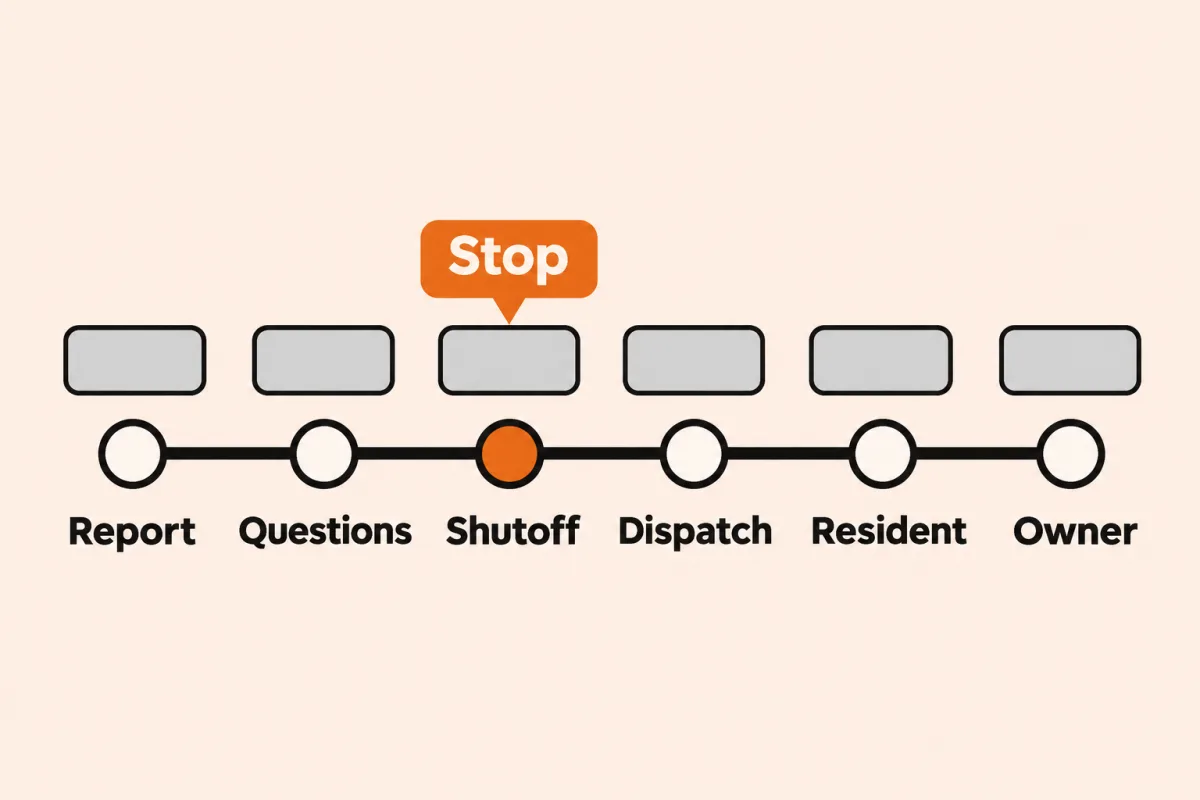
Step one: stop the water
The most useful action is the shutoff. If the resident can reach the fixture valve, such as the one under a sink or behind a toilet, ask them to turn it off. If the leak is from a pipe, a water heater or an unknown source, the next target is the unit's main shutoff, and failing that, the building's. Know where those are before you need them, and keep the locations in the property file with a photo.
Ask short, plain questions. Where is the water coming from? Is it still running? Can you reach the valve? Is anyone hurt, is water near electrical outlets or a ceiling light, or is a ceiling bulging? If water is near electricity or a ceiling looks ready to fall, tell the resident to stay away and leave the area, and send the vendor as an emergency. Do not ask a resident to take a risk to save a floor.
If the resident cannot stop it and you cannot reach the right valve, the vendor's first job is to stop the water, and the repair is second. Say that in the dispatch message. A plumber who arrives and starts diagnosing while water still runs is a failure of the order of work.
Step two: make it safe
Once the water is off or slowed, safety comes before cleanup. Water and electricity do not mix, so if water has reached outlets, switches or a light fixture, the safe path is to leave it alone and send a qualified person. Wet floors can be slippery, and a sagging ceiling can fall. Residents with young children, pets or mobility problems may need a place to stay if the unit is unsafe, and your lease and local rules may say who arranges and pays for it. Ask your counsel before you promise anything.
Photos help everyone. Ask the resident to take a few before they move things, showing the source, the wet area and any damaged belongings. If they are comfortable, ask them to move valuables out of the water's path. Do not ask them to remove ceiling material or deal with anything that could be hazardous. Mold, sewage and long-standing moisture are a vendor's job and may carry notice rules where you operate. The EPA gives the same advice for homes in general: fix plumbing leaks and other water problems as soon as possible and dry everything completely. If the repair disturbs paint in a building built before 1978, the EPA lead-safe repair rule applies to the contractor and to the management company.
Record the time of the first report, the time the water was stopped and who did it. Those two times are the backbone of any later conversation with an owner, an insurer or a resident about what happened.
Step three: send the right vendor
Not every leak needs the same call. A supply line burst needs a plumber now. A slow drip under a sink may need one in the morning. A roof leak may need a roofer and a temporary cover. A leak that started in the unit above needs two units checked. Your emergency list should say which ones are dispatch now and which can wait, and your on-call person should not have to invent that rule at midnight.
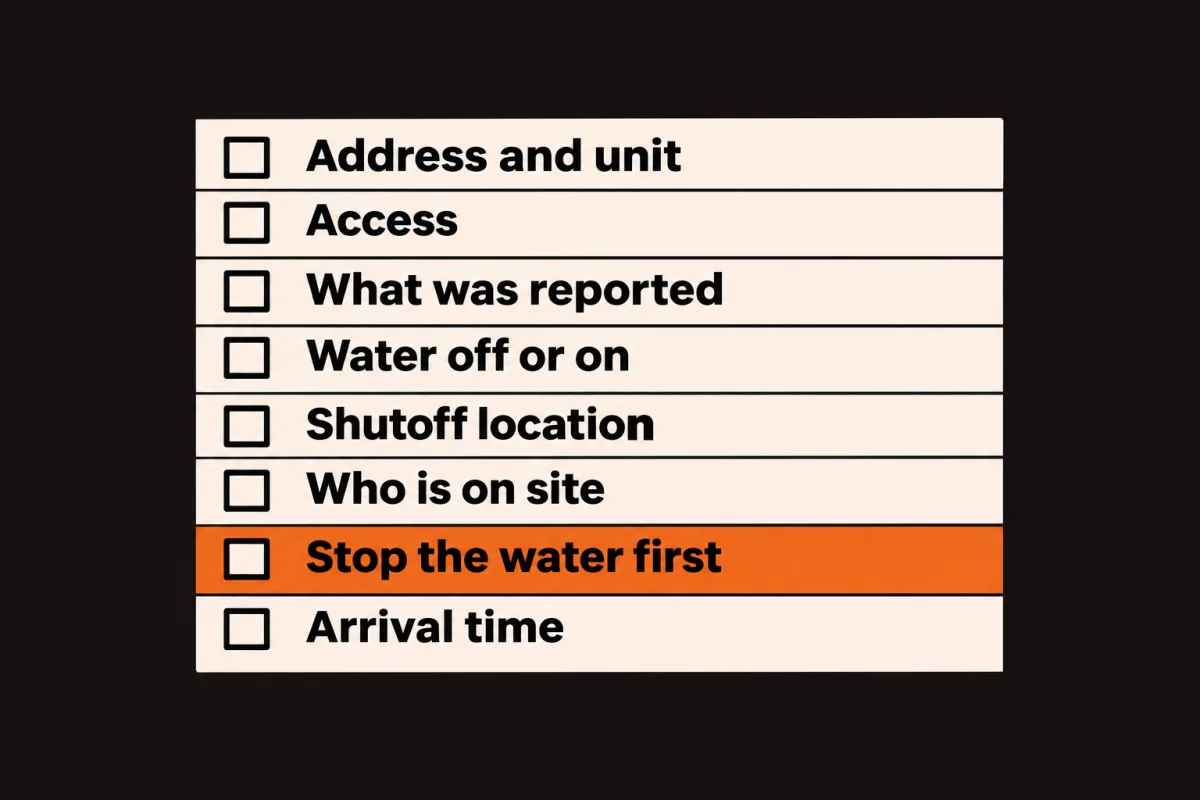
When you dispatch, send the same facts every time: address and unit, access instructions, what the resident reported, whether the water is off, where the shutoff is and who will be on site. Say what you want first, which is to stop the leak and make the space safe, and ask for an arrival time you can pass on. Do not promise the resident a time the vendor has not given you. Check the owner's approval limit, and note that emergency work to protect the property is usually something your agreement addresses. Read yours.
If the first vendor does not answer, move to the next on your list at once, and write down each attempt. Our vendor follow-up email template and the escalation ladder for overdue work orders apply here on a shorter clock.
The first hour of a leak
Write down the time at each step. The times are the record.
Step four: tell the resident and the owner
Residents want to know three things: is someone coming, when, and what should I do now. Answer those, in that order, even before you know the cause. A short message that says the water has been reported, a vendor is on the way and here is what to do until then is worth more than a long one later. When the repair is done, tell them what happened and what comes next, such as drying and repair of the finish. The work order status update template has the wording.
The owner should hear from you the same day, even at night if the damage looks large, and otherwise first thing in the morning. Lead with what happened and what is already done, then what you do not know yet, then what you need from them and by when. Do not guess at costs. Our guide on telling an owner about an expensive repair shows how to keep it factual.
If other units are affected, tell those residents too, with the same three answers. If a building system is involved, make a note to check whether notice about a shutoff or a repair is required where you operate. The water shutoff notice template covers planned shutoffs.
Messages you can adapt
Keep these short, and change the details. The first goes to the resident while the vendor is on the way. The second goes to the owner.
We have your water report: [address, unit]
Hello [resident name],
We received your report of water at [location] at [time]. We have asked [vendor or "a plumber"] to come, and they will contact you directly on [number]. We will confirm an arrival time as soon as we have one.
Until then, if you can do it safely, turn off the valve at [location]. If water is near outlets or a ceiling is bulging, please leave the area and call emergency services if anyone is in danger. Please take a few photos of the water and anything damaged. Thank you,
[name, phone]
Water leak at [address, unit]: update
[Owner name], at [time] a resident reported [what]. The water was stopped at [time] by [who]. [Vendor] [is on site / arrives at time]. What we know: [source, areas affected]. What we do not know yet: [scope, cause]. Resident status: [staying / relocated / informed]. I will update you by [time]. If the work will exceed your approval limit, I will send you the estimate before the repair beyond the emergency stop. [name, phone]
A walkthrough: a night call
Say a resident texts at 10:40 that water is dripping from the bathroom ceiling and the sound is getting louder. The on-call person replies within minutes and asks the short questions: where, still running, anyone hurt, near lights. The resident says it comes from a ceiling vent, there is a bulge, and the light fixture is wet.
The on-call person tells the resident to move away from the bathroom and turn off nothing there. They ask whether the unit above is occupied. They call the plumber from the emergency list, send the standard dispatch message and mention the possible source in the unit above. They text the resident an arrival time that the plumber has actually confirmed.
The plumber finds a supply line failure in the unit above and shuts the water at that unit's valve at eleven twenty. The on-call person writes both times on the work order. They send a short message to the upstairs resident explaining the shutoff, and they message the owner that night with what is known. In the morning, the coordinator books the drying and repair vendors, checks whether an insurer needs notice, and sends both residents an update. The file now shows who reported, who acted and when. That record is what keeps a later conversation about cost or blame short.
Common mistakes
Diagnosing before stopping. The first job is to stop the water. Cause and repair come after.
Not knowing the shutoffs. If nobody can find the valve at midnight, the building floods while people search. Put locations and photos in the property file.
Asking a resident to take a risk. Do not send a resident toward wet electrical areas or a sagging ceiling to save belongings or time.
Promising a time the vendor has not given. Pass on confirmed times only.
Skipping the record. Without times and photos, an insurance conversation or an owner dispute becomes a matter of memory.
Forgetting the unit below or above. A leak in one unit often belongs to another. Check both.
How to adapt it
For a single family rental, the resident may be the only person on site, so your first questions and the shutoff photo carry the most weight. For multifamily, mark each unit's shutoff and the building shutoff on a simple plan, and keep a list of which units share risers. For buildings with a superintendent or in-house maintenance, add them as the first call and keep the plumber as the second.
If your owners carry their own insurance, ask them what notice they need to give after a loss, and tell them promptly when a leak is large. If you carry a policy for the portfolio, check the conditions with your insurer. Rules on who pays for temporary housing, drying and damaged belongings vary by lease and by law, so write down your approach with your counsel before the night it happens.
Use your software to speed the paper. AppFolio, Buildium, DoorLoop and Rent Manager can all create an emergency work order with a priority and a time stamp. Make the first two fields the time of the report and the time the water was stopped.
Where AI helps and where a person decides
AI helps with triage and paperwork. Paste a resident's first message into ChatGPT or Claude, with the name and address removed, along with your emergency list, and ask it to sort the message, list the questions to ask next and draft the work order and the reply. It can write the dispatch message in your format and the owner update from your notes at the end of the night.
A person decides what to dispatch and what to tell the resident about safety. A model cannot see the ceiling, cannot judge whether a situation is dangerous and should never tell a resident that something is safe. It must not promise an arrival time or a cost. Treat every draft as a draft, and keep resident details out of any tool your firm has not approved.
Below is a resident message about water at a rental and our emergency list. Do not give safety advice beyond telling the resident to leave the area and call emergency services if anyone is in danger. (1) Classify the message as emergency, urgent or routine according to the list, and quote the line of the list you used. (2) List the three questions to ask next. (3) Draft a work order summary with source, location and what is known. (4) Draft a two-sentence reply to the resident that does not promise an arrival time. If the message does not say, write MISSING. [paste emergency list, then message]A person reads the classification, makes the call and sends the vendor. The After-Hours Maintenance Agent does this triage pass from your own list.
During and after a leak
- Anyone in danger was told to leave, and emergency services were called if needed.
- The time of the report and the time the water was stopped are written down.
- The right vendor was dispatched with the standard facts and told to stop the water first.
- The resident has an update with a confirmed time only.
- The owner heard the same day, and neighbouring units were checked.
- Photos, messages and invoices are filed, and the insurer was told if required.
- Drying and repair of finishes are booked, and any notice duties were checked with counsel.
Watch: Water Leak Response Checklist for Property Managers
A Sokage AI video for property managers: Water Leak Response Checklist for Property Managers. The guide below has the full template and steps. Watch on YouTube.
Questions
What should a property manager do first when a tenant reports a water leak?
Ask where the water comes from, whether it is still running and whether anyone is in danger. Have the resident stop the water at the nearest safe valve, or dispatch a vendor to do it, and tell them to leave the area if electricity or a ceiling is involved.
Who pays for water damage in a rental?
It depends on the cause, the lease, the insurance policies and local law. Record the times, photos and cause, tell the owner and insurer promptly and have your counsel confirm who bears which cost.
Should I tell the owner about a leak at night?
If the damage looks large, yes, with what happened, what is done, what is unknown and when you will update. Otherwise first thing in the morning. Do not guess at costs.
Can AI triage a water leak report?
It can classify a resident message against your emergency list, list follow-up questions and draft the work order and reply. A person makes the dispatch decision and gives any safety instruction.