Why shutoff notices fail
Most water shutoffs are planned days or weeks ahead. The plumber is booked, the valve is ordered, the window is agreed. Then the morning arrives and a resident steps into the shower, turns the handle and gets nothing. Within minutes the office phone is ringing, the emergency line is ringing, and someone is posting in the building group chat that management never tells anyone anything. The work itself went fine. The communication did not.
The cause is rarely that no notice went out. It is that the notice did not land. It went by one channel only, usually email, and half the building does not read email from the office. Or it went out once, two weeks early, and nobody remembered it by Tuesday. Or it buried the time window in the third paragraph under a polite introduction about ongoing improvements to the property. Residents skim. If the day and the hours are not the first thing they see, they did not see them.
A shutoff notice has one job: make sure every affected household knows when the water goes off and comes back, early enough to plan around it. Everything else is secondary. That is why the template below leads with the window, why it goes out twice, and why the all clear is a message of its own rather than an afterthought.
What the notice says
Six pieces of information cover almost every planned shutoff. Residents need to know whether it affects them, when it starts and ends, and roughly why, because a reason makes people more patient. They need to know what to do beforehand, what to expect when the water comes back, and who to call if something goes wrong. Leave any of these out and you get calls asking for it.
| Line | Example |
|---|---|
| Who is affected | Building B, units 201 to 212 |
| When it starts and ends | Tuesday, 9 AM to 1 PM |
| Why | Replacing a leaking main valve |
| What to do before | Fill a jug, run no laundry after 8:30 |
| After it comes back | Run cold taps a minute if water is cloudy |
| Who to call | Office number, emergency line |
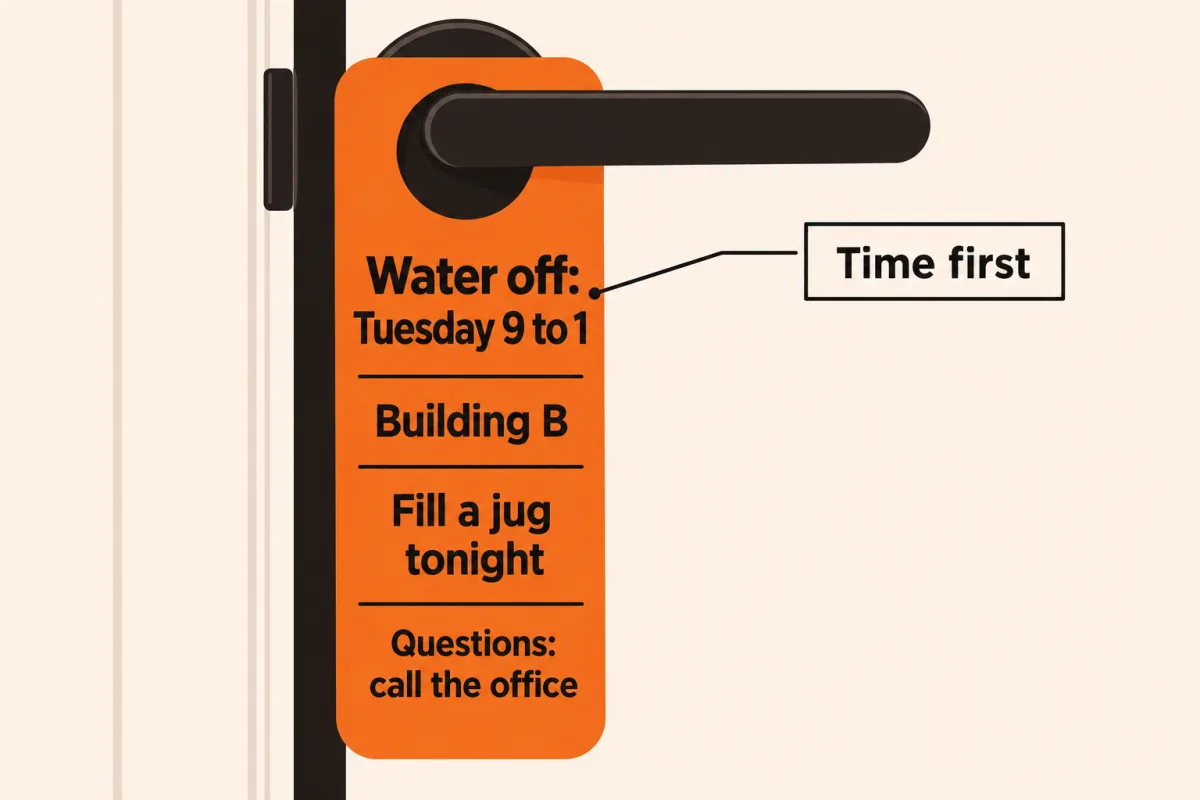
Put the time in the first line, big. That is the only part most residents read. Be specific about who is affected, too. "Some units may experience interruptions" makes every resident in the property wonder whether it means them, and the ones who are not affected call to ask. Name the building, the floor or the unit range.
Keep the reason short and plain. "Replacing a leaking main valve" is enough. Residents do not need the plumbing detail, but a real reason signals that the shutoff is necessary and planned, which heads off the assumption that it is careless.
This is a working template, not legal advice. Notice periods and how notice must be given depend on your lease and on state and local law. Check yours with your own counsel before using it.
The timeline
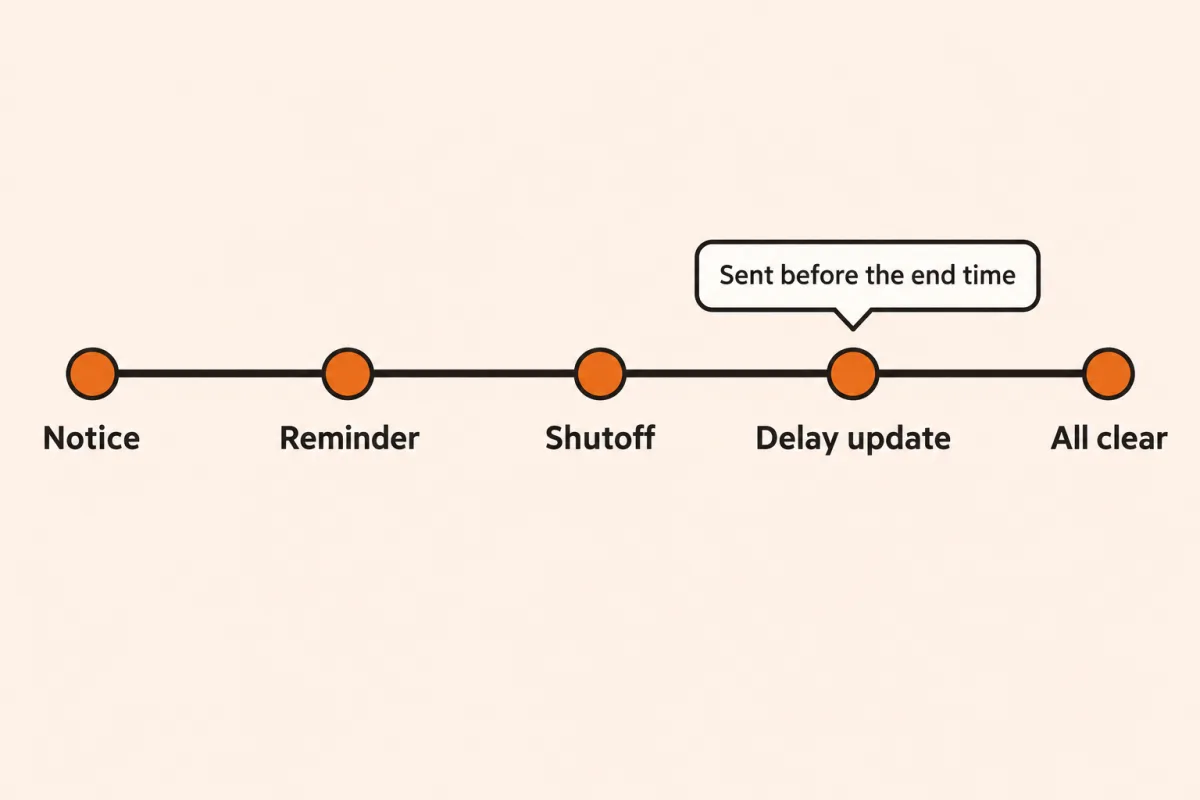
A planned shutoff is a small project with five steps, and the notice is only one of them. Most of the friction comes from the steps around it: a window booked without checking the notice period, no reminder, or no message when the water is back on.
Planned shutoff
If the work runs over, send an update before the end time, not after.
Schedule. Agree the window with the vendor first, and ask them how long the work really takes, not how long it takes when nothing goes wrong. Weekday mornings tend to suit most households better than evenings or weekends, when more people are home and need water. Then count back from the date: if the window falls inside your notice period, move the date rather than shorten the notice.
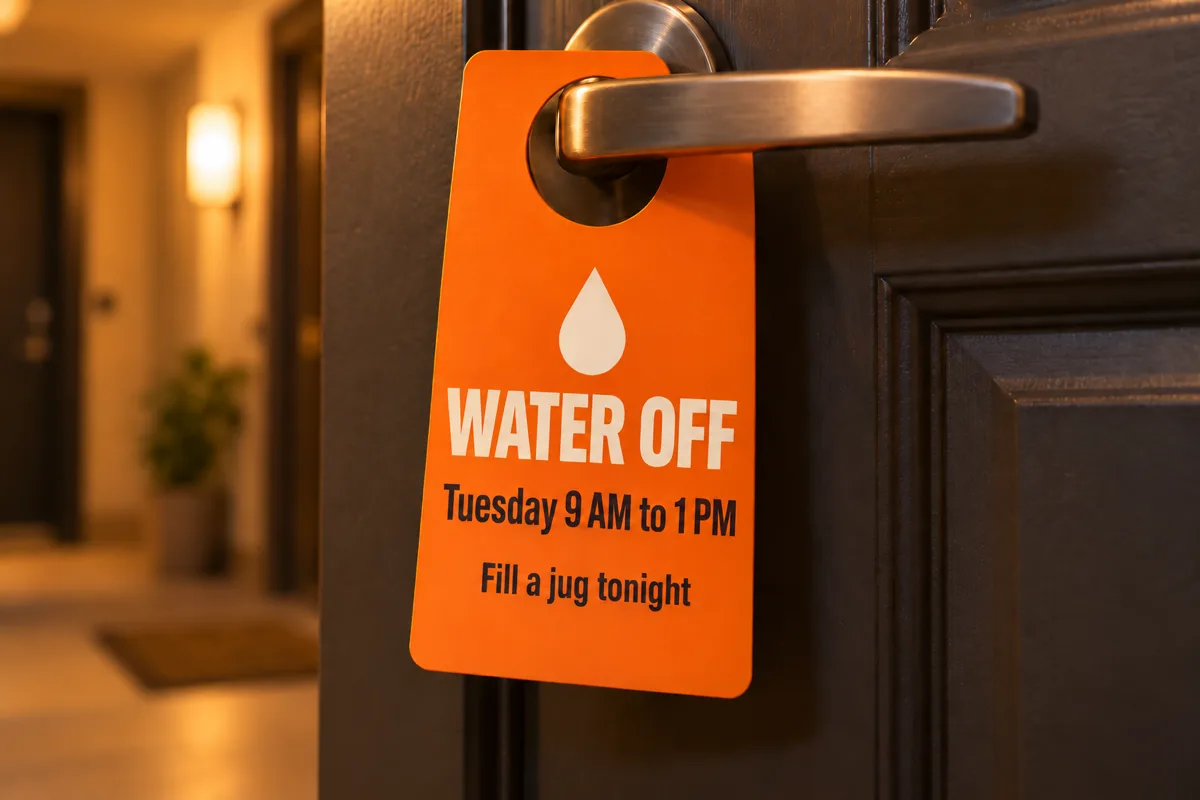
Notice. Send it through every channel you use with residents: email, text, the resident portal, and a printed notice on doors or in the lobby for anyone who reads none of those. The door hanger matters more than it looks. It is the one format nobody can miss.
Reminder. The day before, send a short reminder. One line is enough. This is the message that actually changes behaviour, because it arrives when people can still fill a jug.
Shutoff. Start on time. If the vendor is late, tell residents the window has moved instead of leaving the water on and off unpredictably.
All clear. When the water is back, say so. Without it, residents test their taps all afternoon and call when the pressure is low or the water is cloudy, which is normal for a few minutes after a shutoff.
The notice
Here are the three messages. Keep them in your template library and change only the bracketed parts, so every shutoff sounds the same and residents learn to recognise them.
Water off: [day, date], [start time] to [end time]
Hi residents of [building or units]. We are shutting off the water to [replace or repair what]. Please fill a jug or two for drinking and flushing beforehand, and avoid running the dishwasher or laundry after [time]. When the water comes back on, run your cold taps for a minute if it looks cloudy. Questions: [office contact]. Emergency: [emergency line].
The reminder, the day before
Reminder: water is off tomorrow, [day], [start time] to [end time]. Fill a jug tonight.
The all clear
Water is back on at [building]. If anything is not working, reply here or call [office contact].
A walkthrough: one valve, twelve units
Say a plumber reports a slow leak at the main shutoff valve for one building, and the valve needs replacing. It is not urgent today, but it will get worse. Here is how the shutoff runs when it goes well.
The property manager calls the plumber back and asks for a firm window and a realistic duration. The plumber offers a Tuesday morning and says the job usually takes three to four hours. The manager books it as four hours, because a notice that says 9 to 1 and finishes at 12:30 builds trust, while one that says 9 to 12 and finishes at 1 generates calls.
Next, the manager checks the date against the notice period in the lease and local rules. It clears comfortably, so the notice goes out that afternoon by email, text and portal, and the maintenance tech puts door hangers on all twelve units. The manager also flags any resident they know relies on water at home during the day, such as someone who works from home or a household with a newborn, and sends a personal note so nobody is caught off guard.
On Monday afternoon the reminder goes out. On Tuesday the plumber starts at nine. At half past eleven they find a second corroded fitting and say it will add an hour. The manager sends an update straight away: water will now be back by 2 PM, not 1. Because the update arrives before the original end time, residents adjust instead of complaining. At 1:40 the water is back and the all clear goes out.
Nothing about that sequence is complicated. It just has every step in it, which is what most shutoffs are missing.
Common mistakes
One channel only. Email alone misses a large share of residents. Use every channel you have, and put something physical on the doors.
Burying the time. A friendly opening paragraph pushes the window out of sight. Lead with the day and hours, then explain.
No reminder. A notice sent days ahead is forgotten by the morning. The reminder is the message that gets jugs filled.
Optimistic windows. Booking the shortest possible window means overrunning it. Pad the window and finish early.
Silent overruns. If the work runs long, tell residents before the end time passes. An update after the deadline reads as an excuse.
Forgetting the all clear. Without it, the shutoff feels unfinished and residents keep calling to ask.
When it is an emergency
A burst pipe does not wait for a notice period. Shut it off, then tell residents straight away by text and a note on the doors: what happened, that the water is off, and when you will update them next. Your lease and local law usually allow emergency work without the usual notice; check what yours require afterwards. What counts as an emergency covers the rest.
In an emergency, the promise of the next update matters more than an end time you cannot know yet. "We will update you by 3 PM" is honest and gives residents something to hold on to. Then keep that promise, even if the update is that work is still going. If the shutoff starts after hours, the same rules apply, and your after-hours maintenance policy should say who sends the message.
How to adapt it
For a small portfolio of single-family homes, a shutoff usually affects one household, so a phone call plus a text often replaces the full notice. Write it down anyway, because a dated message is your record that notice was given.
For multifamily buildings, the unit range is the hard part. Check with the vendor or your building records which units sit on the valve being shut, because shutoffs often affect more units than the one with the problem. For mixed-use properties, commercial tenants may need longer notice to plan around closing hours, so check their leases separately.
If your software sends bulk messages to residents, as most property management platforms do, build the three messages as saved templates there so the next shutoff takes minutes. The same structure works for planned power, gas or elevator outages, and for notices of entry when the work needs access to units.
Draft it with AI
AI is good at the repetitive part of this job: filling the template, checking the date against your notice period, and producing the reminder and the all clear in the same tone. Put your notice templates and notice period in a ChatGPT or Claude Project and send:
Draft a water shutoff notice from the template in this Project for [building/units], on [date], from [start] to [end], to [reason]. Check that [date] is at least our notice period after today and tell me if it is not. Then draft the day-before reminder and the all clear. Keep each one short enough to read on a phone.A person still decides the window, confirms which units are affected and reads the notice before it goes out. The AI drafts; you check the facts it cannot know, like whether the vendor's estimate is realistic.
Before you send
- The date meets your notice period.
- The time window is in the first line.
- Every affected unit gets it, by every channel you use.
- The reminder and the all clear are scheduled.
Questions
How much notice do tenants need for a water shutoff?
It depends on your lease and local law. Check what yours require, and give planned notice early enough that residents can plan around it.
What should a water shutoff notice include?
Who is affected, the start and end time, the reason, what to do beforehand, what to do when water returns, and who to contact.
Do I need to give notice for an emergency water shutoff?
Emergency work usually cannot wait for a notice period. Shut it off, tell residents straight away, and check your lease and local rules afterwards.
Can AI write a water shutoff notice?
Yes, from your template. Have it check the date against your notice period, and read it before it goes out.