
The free agent
This is what your owner gets
Attach one closed month. The agent explains every line, re-checks the arithmetic, and builds the owner report: your colour, your logo, saved as a PDF you send yourself.
- Every figure restated, never recalculated. If the lines do not add up to your statement, there is no report at all
- Flags stay on your screen. The owner reads the explanation. You see what needs checking first
- Nothing leaves your computer. The report page runs in your browser, offline
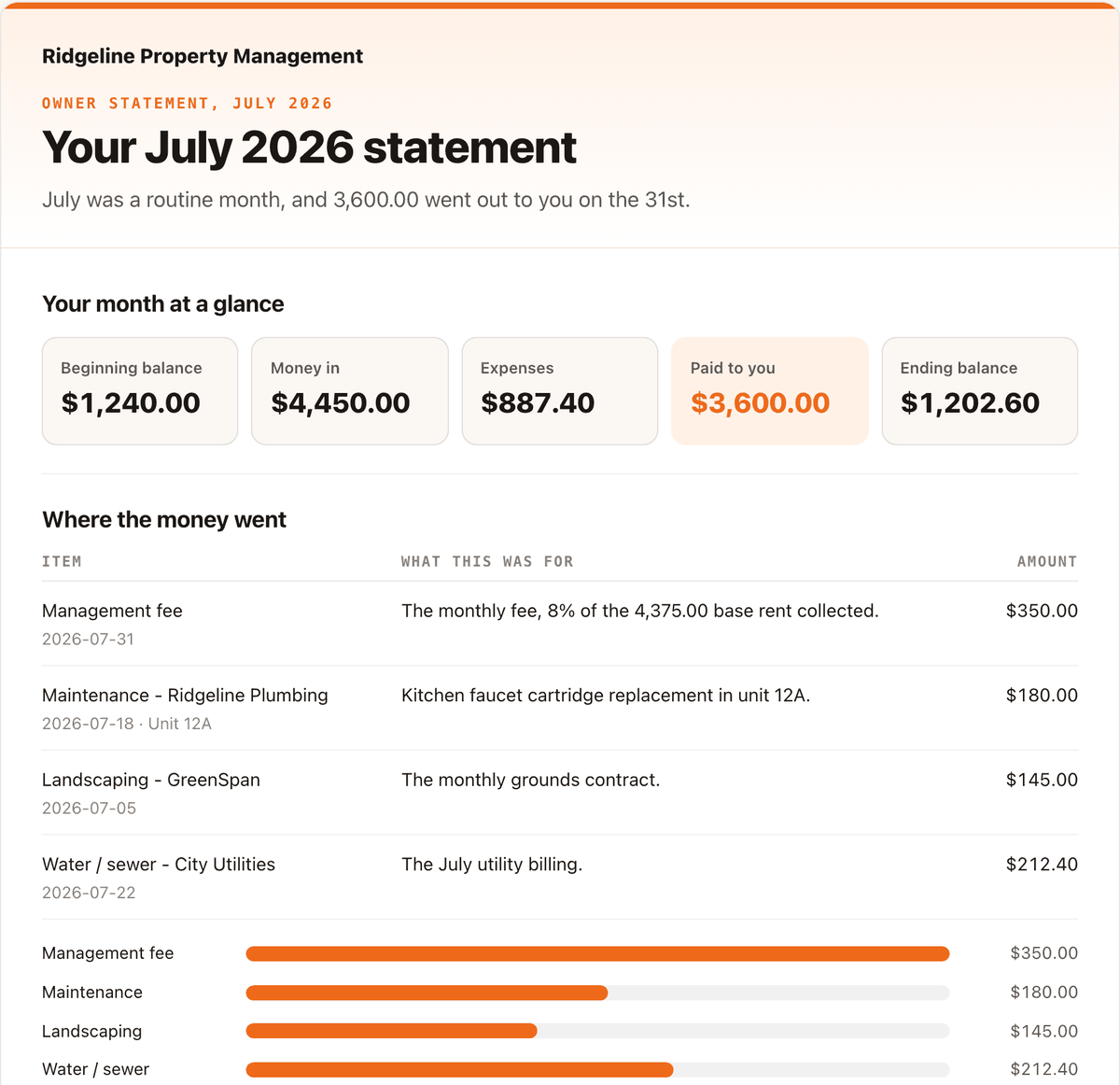
Rendered by the report page from the fictional sample month in the download.
The problem
Your software keeps the record. It does not do the work around it.
It produces a correct owner statement and no explanation, so the owner calls. It logs the after-hours request and does not decide whether it is an emergency, so somebody’s phone rings at 11pm.
Month-end without an agent
- The statement goes out with a vendor name and no explanation
- The owner calls to ask what the charge was for
- Somebody rebuilds the explanation outside the software
- The bad month gets softened, then explained twice
Month-end with the agent
- Every line explained from your own records
- The owner’s likely questions answered before they ask
- A month that does not tie stops before anyone writes to the owner
- You review and send. Nothing goes out on its own
What you get
Everything below, for $199 a month
Or $1,899 a year. Free trial, and you keep every agent you build even if you cancel, they are files, not software.
- Step by step lessons. From choosing the first job to hand over, through setting up Claude or ChatGPT properly, to your first agent running on a real month
- The 7-Day Agent Challenge. One short step a day, and by day seven you have an agent drafting real work
- The full agent library. Owner statements, after-hours maintenance and every agent after them, each with its setup guide and test record
- A new agent every month, and members vote on which job gets automated next
- The prompt playbook. How every agent is built, so you can build your own instead of waiting for us
- The swipe file. Owner emails, tenant notices, vendor messages and late rent sequences, ready to edit
- Rate and fee benchmarks. What comparable firms charge, so you can price with confidence
- The Operator Vault and mastery classrooms. The advanced material, for when the basics are running
- Configuration done with you. Your fee basis, your thresholds, your escalation path. This is where most AI setups quietly fail
- Monthly live build session. One agent built or fixed in front of you, recorded and kept
- Everything is yours to keep. Cancel any time and every agent you built keeps working
Two ways to start
Take one free, or take all of them
Get the free owner statement agent
The Owner Statement Agent, free and yours to keep. Attach one owner’s closed month and get back the email, every line explained in plain English.
It re-checks the arithmetic, and if the numbers do not tie out it refuses to write anything at all.
Published with all 159 of its test runs, so you can judge the standard before you trust anything else we make.
Join the property management AI community
Practical AI classrooms, the published agent library, and a place to get help. Members help shape the monthly build direction.
Step by step lessons, the 7-Day Agent Challenge, the full agent library and a live build session every month.
Free trial. Cancel anytime and keep everything you have built, nothing is hosted, nothing switches off.
The library
Pick the one you would hand over first
Members vote on what gets built next. The list grows every month and nothing on it is fixed.
New to this? Start with the guides, where every piece comes out of an agent we actually built: why owners call about their statement, what counts as an after-hours maintenance emergency, and whether AI can read your property management export.
How they are built
Safe to point at real money
Three rules that hold for every agent, whatever the job and whatever it is built with.
Restates your ledger, never recomputes it
It does not calculate the owner’s money. It restates what your system already produced and re-adds the lines to check them. A mismatch is a full stop.
No send button: a human releases every owner update
Not a setting you could switch on by accident. Structurally there is nothing for it to send with. A human releases every word.
Works on exports, never touches your property management API
Buildium confirms there is no feature for sending owner statements automatically. DoorLoop states there is no way to send an owner statement automatically. Exports are the only route that exists on the tiers most firms are on.
Who built this
Built by people who do this professionally
Sokage is built by a team that designs AI agents for a living. 780+ agents shipped for 300+ companies.
The team includes property managers and people who run property management companies. Most of that work was in industries where a wrong number has consequences, which is why these agents restate rather than recompute, and stop rather than guess.
Questions
Frequently asked questions
Do I need to be technical?
No. You paste a prompt into Claude or ChatGPT once, fill in seven settings about your firm, and then each month you attach the export your software already produces. There is nothing to install and no code anywhere.
Which software does it work with?
They work from exports. The agents read the file you export from AppFolio, Buildium, DoorLoop, Rent Manager, Propertyware or a spreadsheet, rather than connecting to the system. Check the required fields against your own file first, because we have not validated every vendor's export format.
What happens if I cancel?
You keep every agent you have built. They are files, not software. Your downloaded files remain yours to use under their license. Your AI provider's terms still apply. That is the whole reason we can say it.
Will it send anything to my owners or tenants?
No, and not as a setting. structurally there is nothing for it to send with. It drafts, you read it, you send it from your own account.
How do I know it will not invent a number?
Every agent restates figures your accounting system already produced. A missing figure is reported missing rather than filled in. The free agent is published with all 159 of its test runs, including five attempts to hijack it through its own data, so you can check rather than take our word.
Which AI model do I need?
It was built on Claude Opus 5 and verified on Sonnet 5 and Haiku 4.5. The safety guards held on all three, so you do not need the top tier. Claude Pro is $20 a month for regular use.
How often does a new agent arrive?
One a month, and members vote on which. The request queue is a vote, not a suggestion box.
Is my data safe?
Nothing passes through us. The agents run in your own Claude or ChatGPT account, on files you choose to paste or attach. We never see any of it.
Start your 7-day free trial of the Sokage AI community
Cancel anytime and keep every agent you have built. Or take the free one first and decide later.
Not ready? Get the free agent and judge the standard yourself.