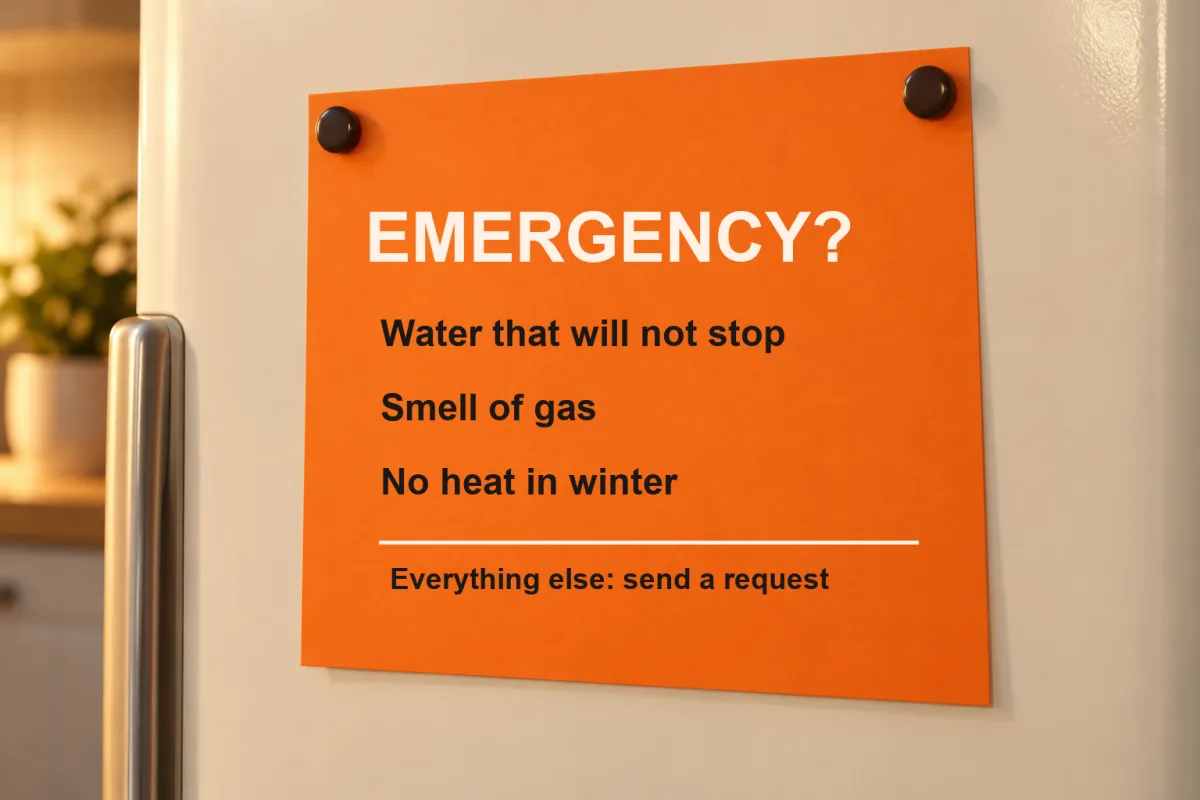
Why residents guess wrong
From the resident's side, a maintenance problem at night feels urgent almost by definition. The dishwasher will not drain, the bedroom light flickers, the heating is making a new noise. They have no way to know whether it is a nuisance or the start of something serious, and nobody has told them where the line is. So they do one of two things: call the emergency line about everything, or call about nothing and hope it lasts until morning.
Both cost money. Calls about minor problems wake the on-call person, wear them out and, if a vendor goes out, run up after-hours rates for work that could have waited. Silence about a real emergency is worse: a slow leak left overnight can turn into a ceiling repair, mould remediation and a displaced household. The same resident can make both mistakes in the same year.
A clear list fixes the guessing. It gives the resident a simple question to ask themselves, and a short answer. It also protects the on-call person, because when a resident calls about something on the "submit a request" side, the reply is easy and friendly: thank you, that is on the morning list, here is what happens next.
What the list is for
The list does two jobs. It tells a resident when to call the emergency line, and it tells them what to do first while they wait. Both reduce damage, and both reduce calls that could have been a request in the morning.
It does not replace your lease, your policy or local law. It is the resident-facing version of them. If you do not have an after-hours maintenance policy yet, write that first, because the list is only as good as the policy behind it.
Two groups, not ten
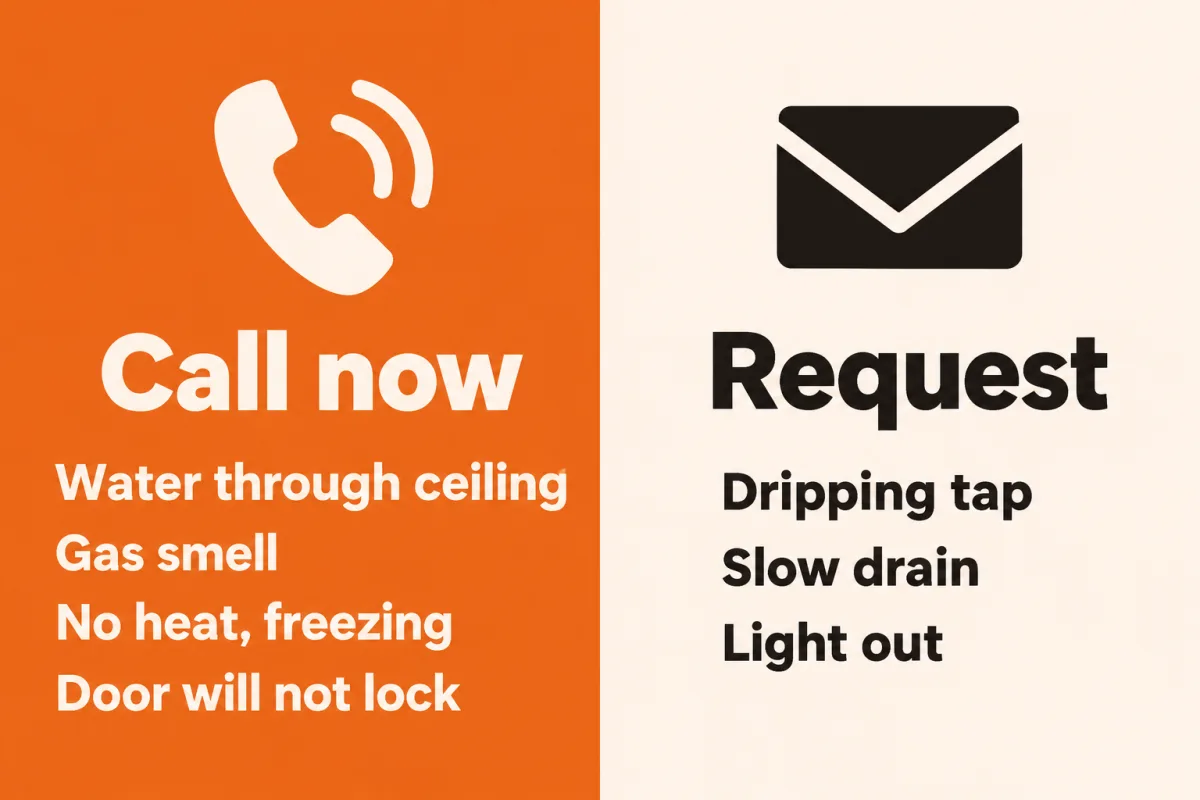
Keep the list to two groups: call now, and submit a request. A third group invites an argument. Put the borderline items in the one your policy says.
| Call the emergency line now | Submit a request, we will respond in business hours |
|---|---|
| Fire, smoke or a smell of gas: leave first, then call your local emergency number | A dripping tap |
| Water that will not stop, or a burst pipe | A slow drain |
| Sewage backing up into the home | A broken appliance that you can live without |
| No heat in cold weather, where your policy treats it as an emergency | A loose cabinet door or a cosmetic problem |
| A door or window that will not lock, leaving the home open | A burned-out light you can reach |
| Electrical sparks, burning smell or a power loss in part of the home | A noisy fan |
Write each item in the resident's words, not the maintenance team's. "Water coming through the ceiling or walls" is clearer than "active leak". "No heat when it is freezing outside" is clearer than "HVAC failure". The resident is reading this half asleep, so plain words win.
Your own list will differ. Climate, building type, equipment and lease terms all change it. Hot water, for example, depends on your policy, and the no hot water triage table shows how to decide.
Put the first action next to each item
A resident who knows what to do in the first five minutes can save a ceiling. For each emergency, add one line of what to do while waiting.
| Problem | First action while you wait |
|---|---|
| Burst pipe or water that will not stop | Turn off the water at the shutoff valve if you know where it is |
| Smell of gas | Leave, do not use switches or flames, call from outside |
| Electrical sparks or burning smell | Leave the area and do not touch the panel |
| Sewage backup | Stop using sinks, toilets and showers |
| Door will not lock | Tell us if you feel unsafe, and call your local emergency number if you do |
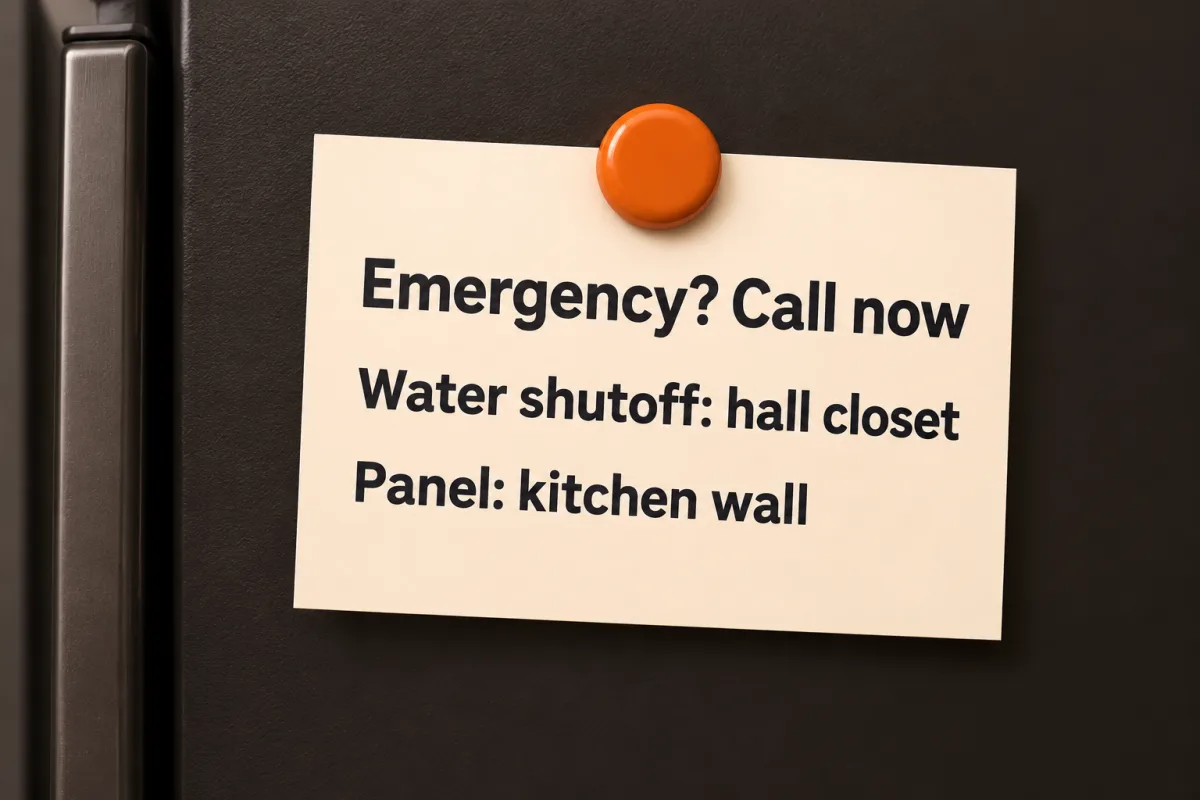
Put the location of the main shutoff for each building on the sheet or in the welcome packet. If it differs by unit, print it per unit.
When a resident calls
The resident should never have to decide in the dark. The sheet decides for them.
The template
Maintenance emergencies: what to do at [property name]
Call [emergency line] right now, any hour, if:
- [Item 1, with the first action]
- [Item 2, with the first action]
- [Item 3, with the first action]
- [Item 4, with the first action]
For anything else, submit a request at [portal or email] or call [office] during business hours ([hours]). We will reply by [time].
If anyone is in danger, call your local emergency number first, then us.
Main water shutoff for your building is at [location]. Main electrical panel is at [location].
When you call, tell us your name, address, unit and what is happening. Stay reachable at the number you give us.
Keep it to one page. If it needs two, the list is too long.
What the on-call person needs from the resident
The last lines of the template are not filler. When a resident calls at night, the on-call person has to decide quickly whether to send someone, and they can only decide on what they are told. The resident's name, address and unit, a callback number and one sentence on what is happening save several minutes of back and forth.
A photo or a short video helps even more. A picture of the water on the floor, the error code on the furnace or the crack in the window tells the on-call person in seconds what a phone description takes minutes to explain. If your emergency line can receive texts with photos, say so on the sheet.
Ask residents to stay reachable after the call. Many after-hours problems are resolved by a second call walking the resident through a reset or a shutoff, and that only works if they answer. It also helps the on-call person close the loop: once the immediate problem is handled, they can tell the resident what happens in the morning and log the call properly.
How to hand it out
- At move-in. Put it in the welcome packet and walk through it. The move-in welcome letter is a good place to point to it.
- On the portal or website. One link anyone can find.
- On the door or the fridge. A printed sheet or magnet outlasts an email.
- Each autumn. A short reminder before heating season, and before storms where they apply.
A resident who has seen the list once is far more likely to use it at 2 AM.
This is a working template, not legal advice. What counts as an emergency, response duties and required wording depend on your lease and on state and local law. Check yours with your own counsel before using it.
A walkthrough: one night, three calls
Say a building of thirty units gets three calls to the emergency line on the same night, after the list went out with the move-in packets and a reminder before winter.
At 9 PM a resident calls because water is coming through the ceiling of their bathroom from the unit above. That is on the "call now" side. They have already closed the bathroom door and put towels down, because the sheet told them to. The on-call person reaches the upstairs resident, who finds an overflowing toilet and shuts the valve behind it. A plumber is booked for the morning to check for damage. The call takes fifteen minutes and the damage stays in one room.
At 11 PM a resident texts that their kitchen faucet drips. It is on the "submit a request" side, and the text says so: they read the sheet and just wanted it logged. The on-call person creates a request for the morning and replies with a one-line confirmation. Nobody is woken up.
At 2 AM a resident calls about a smell of gas. The sheet says to leave the unit and call the gas utility or the local emergency number first. They did, and then called the emergency line. The on-call person follows the policy, contacts the utility to confirm they are responding, and checks on the neighbouring units. In the morning, the manager logs all three calls and updates the owner on the leak.
Without the list, the faucet would likely have been a phone call at 11 PM, and the leak might have been a text left until morning. The list did not change what happened in the building. It changed who reacted, how fast, and how much it cost.
Common mistakes
A list that is too long. Ten categories mean the resident cannot remember any of them. Keep it to two groups and the handful of items that really need a call.
A list that contradicts the policy. If the sheet says call about no hot water and the on-call policy says that waits until morning, the on-call person is set up for an argument at midnight. The sheet must match the policy exactly.
No first action. Telling a resident to call about a leak without telling them where the shutoff is wastes the most valuable minutes.
Handing it out once. A sheet given at move-in three years ago is gone. Reissue it before the season when emergencies rise, such as before winter in cold climates.
Promising response times you cannot keep. If the sheet says someone will be there within the hour, make sure that is true at 3 AM on a holiday weekend.
How to adapt it
For single-family homes, the list should cover equipment the resident is responsible for, such as the water heater, the sump pump or the furnace filter, and say where the shutoffs are in that specific house. A short walk-through at move-in, pointing to each shutoff, is worth more than any sheet.
For multifamily buildings, add building-level items: fire alarms, elevator entrapment, a building entry door that will not lock, flooding in a common area. Residents should know these go to the emergency line even if their own unit is fine.
For climate, adjust the heating and cooling lines. Loss of heat in a freezing climate and loss of cooling in extreme heat can be emergencies; in a mild climate they may not be. Your policy decides, and the sheet says what the policy says. Have counsel check any local rules on habitability and response times.
Keeping the list current
Review the list whenever the policy changes, the emergency line changes or you add a building. Look at the after-hours call log every few months: if the same non-emergency keeps coming in, it probably belongs on the sheet by name, in the "submit a request" group. If a real emergency was reported late, check whether the list was clear about it. The list is only useful if it describes what actually happens at your properties.
Draft it with AI
Put your lease language, your after-hours policy and the template above in a ChatGPT or Claude Project, then send:
Using only the policy and template in this Project, draft a one-page emergency maintenance sheet for residents of [property], with the emergency line [number] and office hours [hours]. Use the "call now" items from the policy, and add the first action for each. Put every other item under "submit a request". Keep the language plain, readable on a phone, and under 250 words. If the policy does not say whether an item is an emergency, list it under "ask us" and tell me which items those are so I can decide.Have a person read the sheet and compare it with the policy. A list that promises a response your on-call cannot give is worse than no list.
Before you hand it out
- Every "call now" item matches your written policy.
- The emergency number reaches a person at every hour you promise.
- Shutoff and panel locations are correct for each building.
- It fits on one page and is readable on a phone.
- Your counsel has seen the wording.
Questions
What counts as a maintenance emergency for a tenant?
Usually fire, gas, flooding, sewage backup, no heat in cold weather and a home that cannot be locked. Your lease, policy and local law set the exact list.
What should tenants do before maintenance arrives?
Stop the damage if it is safe to, for example by shutting off the water, and leave the area if there is gas, smoke or sparks. Then call the emergency line.
How long should an emergency list be?
One page, in two groups: call now and submit a request. A longer list invites arguments and does not get read.
Can AI write a tenant emergency list?
It can draft one from your policy and lease language. A person checks it against the policy and confirms the response times can be met.