Why after-hours maintenance wears firms down
Daytime maintenance has backup. There is a coordinator at a desk, the vendor's office is open, and the manager is down the hall to settle a question. At night, all of that disappears. One person is holding a phone, half awake, with a resident who is scared or angry on the other end and very little information to go on.
That person is making a real business decision with money on both sides. Send a plumber for a slow drain and the owner gets an after-hours bill for a job that could have waited until morning, then calls to ask why. Leave a real leak until morning and it can turn into a ceiling, a mold problem and a displaced household. Most firms have no written rule for the gray area in between, so the answer depends on who picked up the phone and how long since they last slept.
The cost shows up in places that are easy to miss. On-call staff burn out and quit. Vendors get called for things they consider nonsense and stop answering. Owners lose trust when charges seem arbitrary. Residents learn that calling at night gets faster service than filling in a request, so the call volume climbs, and the problem feeds itself.
You fix this with a system, and the parts are all simple. Decide what counts ahead of time, write it down, tell the residents, put a named person on the phone, line up vendors, keep a log and hand it all over each morning. The rest of this page goes through those parts in order, and each one works better when the one before it is done.
The after-hours system
Each part leans on the one before it. Most firms start with the on-call phone and never write the first two.
Decide what counts as an emergency
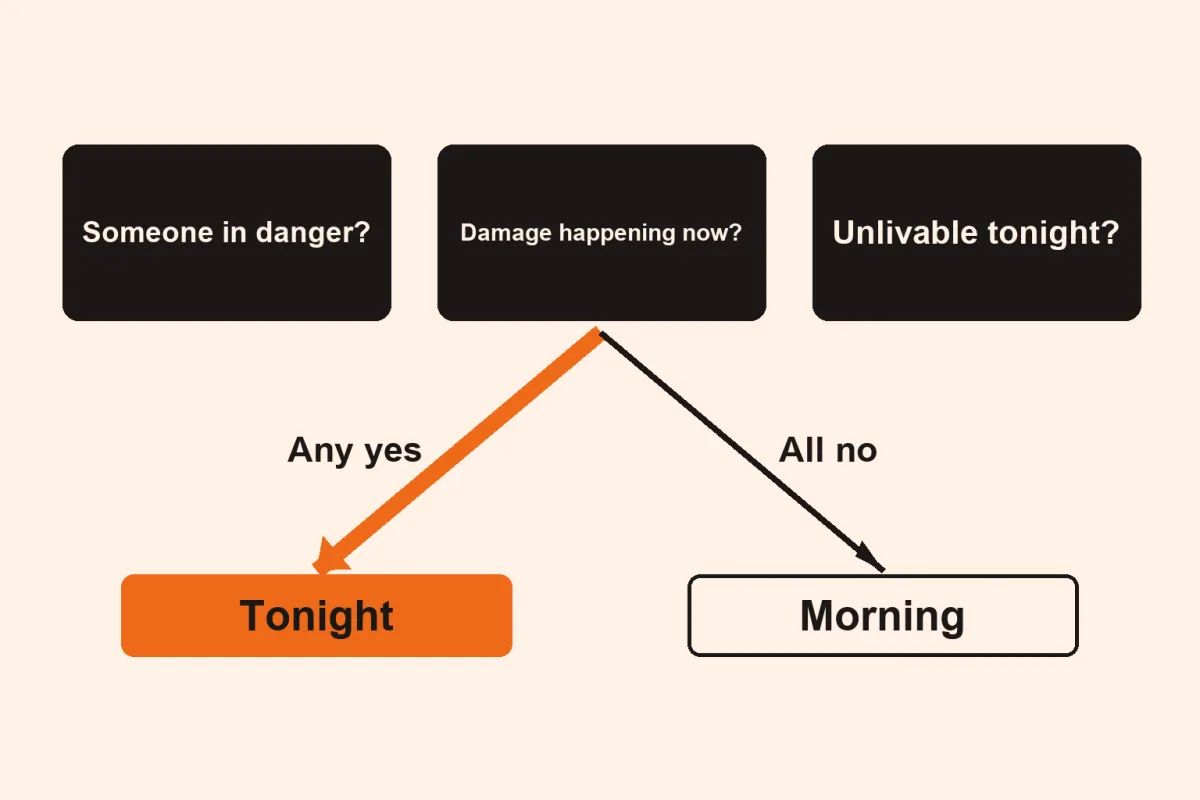
Everything starts here. A workable definition of an emergency comes down to three questions: is someone in danger, is the property being damaged right now, and is the home unlivable or unsecured tonight? If the answer to any of them is yes, it probably cannot wait. If all three are no, the request can usually wait until morning, even when the resident is upset about it.
Most calls are easy to sort with those questions. A smell of gas is an emergency. A dripping tap is not. The difficulty sits in the middle: no hot water, no heat on a mild night, a dead refrigerator, a single toilet not working in a home with one bathroom. These turn on details like the season, who lives there and what else in the home still works, and they are the calls your policy has to decide in advance.
Our guide on what counts as a maintenance emergency goes through the common cases, and the no hot water triage table shows how to reason through a gray-area call. Habitability rules and required response times vary by state and lease, so have your counsel look at your list before you treat it as final.
| Usually tonight | Depends on your policy | Usually the morning |
|---|---|---|
| Fire, smoke, smell of gas: local emergency number first | No hot water | Dripping faucet |
| Water that will not stop, or water through a ceiling | Refrigerator not working | Slow drain |
| Sewage backing up | Only toilet not working | Appliance you can live without |
| Sparks or a burning smell | Loss of cooling in hot weather | Cosmetic damage |
| Home cannot be locked | Power out in part of the home | Noisy fan |
This is a working template, not legal advice. What counts as an emergency, habitability duties, response times and required wording depend on your lease and on state and local law. Check yours with your own counsel before using it.
Write the policy on one page
A policy turns a judgment call at 2 AM into something the on-call person can look up. It does not have to be long. In fact it should not be, because a tired person will not read four pages, and a new hire will not remember them. What matters is that it answers the questions that come up at night and that the answers are written down before anyone needs them.
The questions are about authority as much as about plumbing. Who may dispatch a vendor? Up to what amount, without calling the owner? When does the manager get woken up? What happens when the owner cannot be reached and the water is still running? An on-call person without those answers either freezes or spends money they were not meant to spend, and either way someone blames them in the morning.
The after-hours policy template has the wording. Check it against your management agreements, since many of them set an owner's approval limit and say what you may do in an emergency without approval. If those agreements disagree with your policy, the on-call person is stuck in the middle, and the owner holds the signed document.
| Question | What the policy needs to say |
|---|---|
| What counts? | Your list, including the gray-area calls |
| Who answers? | The on-call role, the hours, the backup |
| Who can dispatch? | The role, and the spending limit without approval |
| When do we wake the manager? | Injury, fire, displacement, anything over the limit, press or police |
| What if the owner is unreachable? | What the management agreement allows, and who decides |
| Who pays? | Owner, resident or reserve, by cause, as your lease and agreement say |
| What gets written down? | The call log fields, by when |
Tell residents before the night comes
Most unnecessary night calls come from residents who do not know where the line is. That is not their fault. Nobody told them. A one-page list given at move-in sorts problems into two groups, call now and submit a request, and adds what to do first while they wait. Our tenant emergency maintenance list has a template you can adapt.
Two details do most of the good. Say where the water shutoff is, because a resident who can close a valve can save a ceiling. And say what you need from them when they call: name, address, unit, a callback number, one sentence on what is happening, and a photo if they can send one. Those save minutes on the phone at the worst possible hour.
Then keep the message consistent. If the voicemail, the portal, the sheet on the fridge and the welcome letter all give different numbers and different rules, residents will call whichever feels fastest. Reissue the list before the season when emergencies rise, such as ahead of winter in cold climates.
Choose who answers the phone
Firms generally pick from three setups. In-house on-call means staff take turns with a phone. An answering service takes the call and follows a script, then reaches your on-call person when the script says to. A tool-assisted setup uses software or AI to take the first message, sort it by your rules and pass it to a person. Each one still ends with a named human who can make the decision.
Choose by portfolio and by what your team can sustain. A small firm can run in-house, but with one or two people on rotation it wears them out fast, and the first resignation breaks the schedule. An answering service gives you a live voice and a script, but it can only follow what you write, so a vague script produces vague calls and too many middle-of-the-night transfers. AI handles the sorting and the drafting consistently, and it still needs a person behind it for anything real.
We are not listing prices here, because they change and depend on volume. Get quotes in writing, ask what counts as a billable call, and ask to hear how a scripted call sounds. Whichever you choose, test it yourself: call the line at night from a number they do not recognize and say you have water coming through a ceiling. How that goes tells you more than any sales call.
| Setup | Fits best when | Watch out for |
|---|---|---|
| In-house on-call | Small portfolio, staff who know the buildings | Burnout, no backup, uneven decisions |
| Answering service | Enough volume to need a live voice at all hours | A weak script, too many transfers, per-call cost |
| AI or software first, then a person | Mostly text and portal messages, written rules already in place | Needs clear rules and a person on the end who responds |
Run the on-call rotation like a real shift
On-call fails most often for human reasons. The same two people carry it for months. They get no time back after a bad night. The schedule lives in someone's head, so a resident's call goes to the person who left on Friday. None of that shows up until someone quits or a real emergency goes unanswered.
Keep the rotation visible in a shared calendar, and make one number follow the schedule, so residents never need to know who is on. Name a backup for every shift, and write down what happens if the first call is not returned within a set time. Then make the handover real: the person coming off tells the person coming on what is still open, including the leak that was stopped but not repaired.
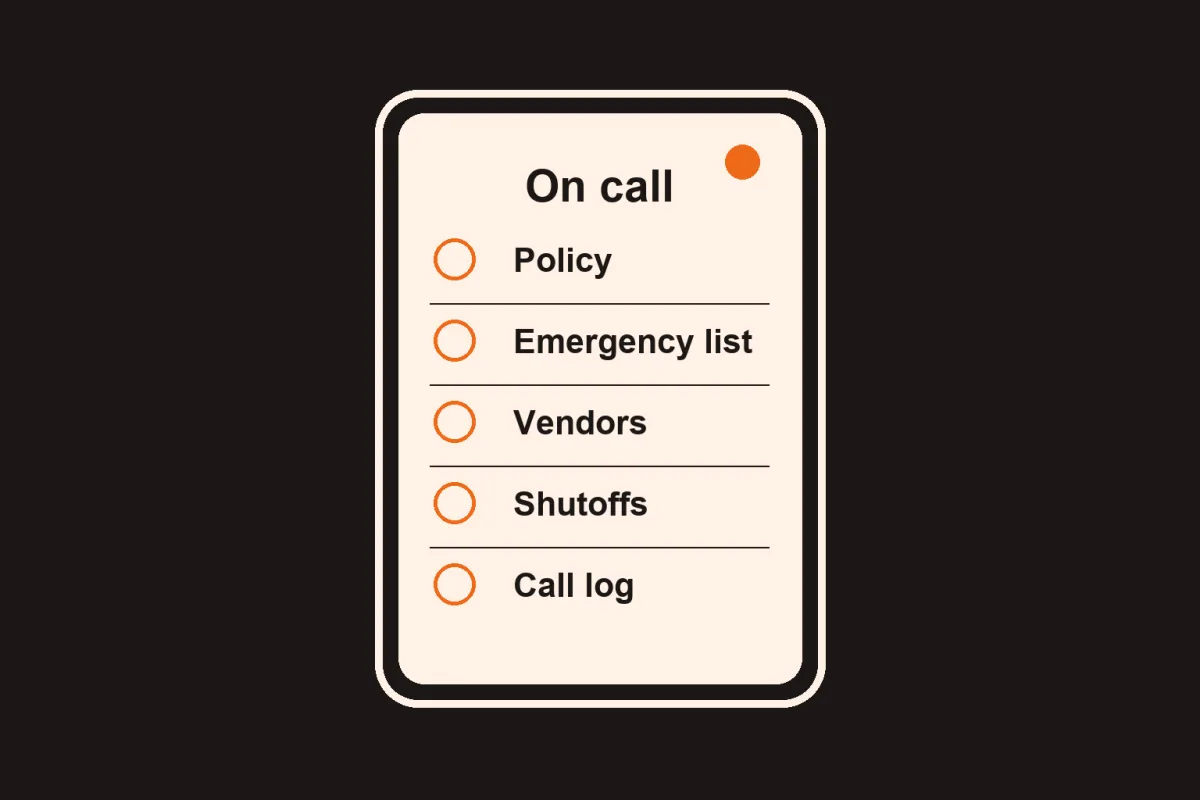
Give the on-call person what they need in one place: the policy, the emergency list, the vendor list with after-hours numbers, shutoff locations per building, the owner limit rule and the log. A phone with a shared folder is enough. If they have to search through email at 2 AM for a plumber's number, the system has already failed them. Pay and time off for on-call duty are employment questions, so check them with your counsel or HR adviser.
Line up vendors before you need them
The worst time to find a vendor is during the emergency. For each trade you might need at night, know who answers, what the rate is, and how they want to be reached. Plumbing, heating and cooling, electrical, locksmith and water damage are the usual list, adjusted for your buildings and climate. Our vendor onboarding checklist covers the documents and rules to have in place first.
Name a primary and a backup for each trade, and ask each one directly whether they take night calls. Plenty of good daytime vendors do not. Agree on the after-hours rate in writing so the invoice has no surprises, and agree on who authorizes the dispatch, so a vendor knows to do the work your on-call person asked for and call before going beyond it.
After each night call, the work order should carry what the vendor found and what is left to do, because many night visits only stop the damage and the repair follows in daylight. If a vendor keeps not answering at night, the vendor scorecard gives you the record to decide who gets the next call. For the ones who answered and then went quiet, use the vendor follow-up email.
What to say on the call
The first minute of the call has a fixed order, and it helps to have it on a card. Check that everyone is safe, and if not, send them to the local emergency number first. Get the name, address, unit and callback number. Ask what is happening, and what they have done so far. If there is something they can do to limit damage, like closing a valve, walk them through it. Then tell them what happens next and when they will hear from you.
Keep promises narrow. "I am calling the plumber now, and I will text you once I know their arrival time" is a promise you can keep. "Someone will be there in an hour" is one you may not be able to. Residents who know what is happening usually stay calm, and those who feel ignored call back, post about it, or call the owner.
When the call turns out not to be an emergency, say so kindly and give the reason in terms of the policy. Log it, tell them it is on the morning list, and tell them when they will hear from someone. You will have an easier conversation with the sheet in their hand, because you are pointing to a rule they have already seen. Do not argue, and if they say the situation is unsafe, take that seriously and ask more questions.
Reply for a request that can wait until morning
Thanks for letting us know about [problem] at [address, unit]. This is not something we send a vendor for overnight, under our maintenance policy, so I have logged it for the morning team. [Name or role] will contact you by [time] tomorrow. If it gets worse, or you see [specific change, such as water spreading], call this number right away.
Reply for an emergency, once a vendor is on the way
[Vendor] is on the way to [address, unit]. I will send you their arrival time as soon as they confirm it. Until then, please [first action, such as keep the water off at the valve]. If anyone is in danger, call your local emergency number first. I am at this number if anything changes.
Keep a call log, and hand it over each morning
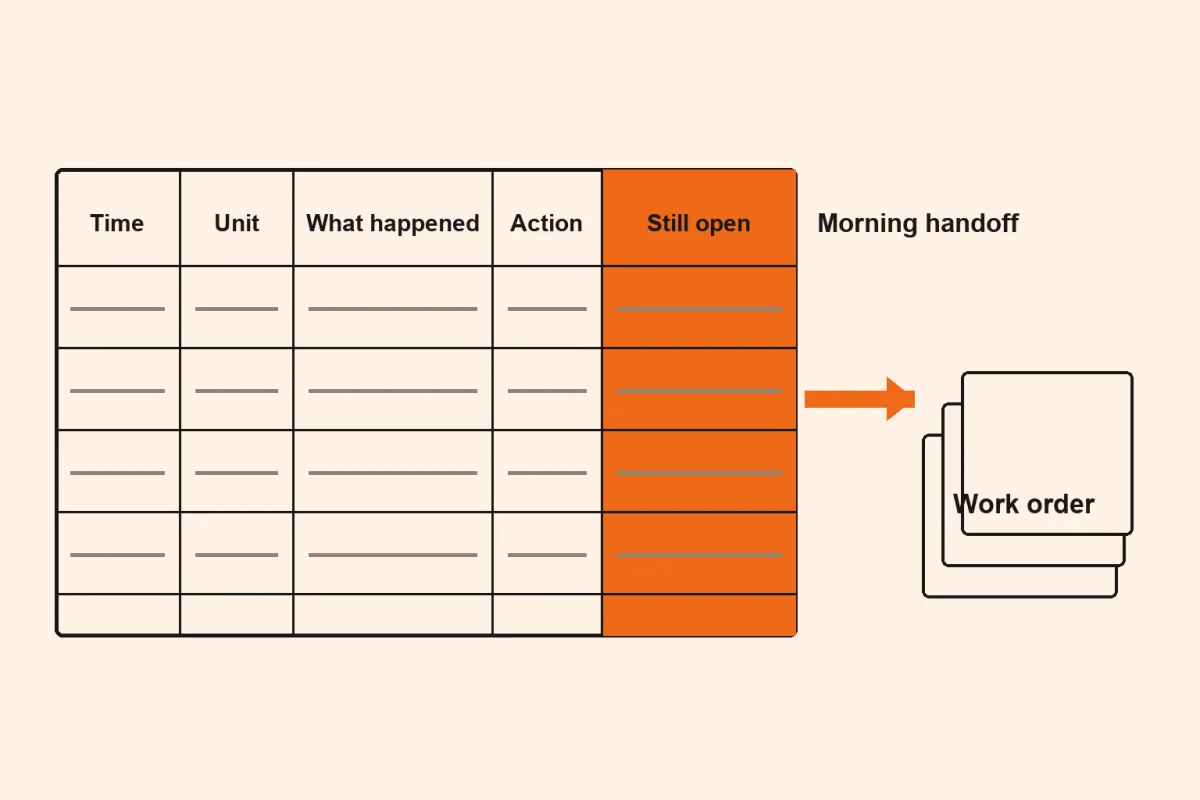
The log is what makes after-hours work visible, and it is your protection when someone asks a question three weeks later. Keep the fields few, or they will not get filled in at night: time of the call, who called, property and unit, what was reported, how it was classified and why, what was done, which vendor was sent and when they arrived, and what is still open. A shared sheet or your software's work order record both work, as long as it happens before the person goes back to sleep.
The morning handoff turns that log into daytime work. Set a time, early, when the coordinator reads the log with the person coming off call, even if it is only a five-minute conversation or a written note. Every open item becomes a work order with an owner and a date. Every resident who was told "we will contact you in the morning" gets contacted, because that promise is the first thing to fall through when nobody is assigned to it.
Residents should keep hearing from you once the emergency has passed. The stopped leak still has a repair coming, and silence after the night visit is what brings the phone calls back. The work order status update has short messages for each stage. If the fix means shutting water off for the building, use the water shutoff notice.
From the night call to the owner update
If a promise went into the log, it gets an owner in the morning.
Tell the owner, the same day
Owners rarely object to a real emergency. They object to finding out about it from a statement a month later. A short message the same morning, with what happened, what you did, what it cost or is likely to cost and what comes next, heads off most of those calls. When you spent money under your emergency authority, say so plainly and point to the clause that allows it.
Send this message before the vendor's invoice arrives, while you still have only an estimate, and say that it is an estimate. Then send the final number when it comes. If the repair is large, the guide on telling an owner about an expensive repair has the wording, and if the account cannot cover it, the owner contribution request follows naturally.
Owner update after an overnight emergency
Hi [owner],
Last night at [time], the resident at [property] reported [what happened]. Under your management agreement we sent [vendor], who [what they did]. Nobody was hurt, and [state of the home now].
The cost so far is an estimate of [amount from vendor], and we will send the invoice when it arrives. The next step is [repair], and [what you need from them, or "you do not need to do anything"].
[Name, phone]
A walkthrough: one Saturday night
Say a firm has a one-page policy, an emergency sheet in every welcome packet, and one number that follows the on-call calendar. On Saturday at 11 PM a resident calls because water is dripping through the kitchen ceiling. The on-call coordinator asks whether anyone is in danger and whether the power is on near the water, then calls the resident upstairs, who finds a supply line leaking under the sink and closes the valve behind it, as the coordinator suggests.
The water stops. Is it still an emergency? The policy says water through a ceiling is, but the damage has now stopped. The coordinator looks at the policy, which says active water gets a vendor and stopped water gets a morning visit unless there is an electrical risk. No light fittings are near the wet patch. They tell both residents what happens next, text a photo of the ceiling to the log, and leave a message with the plumber for first thing.
At 1 AM a different resident calls about no hot water. The weather is mild, and the policy puts this in the morning group unless there is a vulnerable person in the home, so the coordinator asks. There is not. They read the morning reply from the card, and the resident is not thrilled but accepts it, since the same rule is on the sheet on their fridge.
On Monday morning the coordinator and the manager go through the log in a few minutes. The plumber's repair goes on a work order, the ceiling gets a drying check, and the owner receives the short update above before 9 AM with an estimate. The no hot water call has already been handled over the weekend under the policy, and the invoice arrives with the same details as the log, so nobody has to reconstruct anything from memory.
Common mistakes
Treating the phone as the system. A number and a rotation with no policy behind them leave each person making up the rules. Write the policy first, even if it starts as a rough page, and put the phone on top of it.
Rules that differ from the lease or the management agreement. If your sheet says one thing and the agreement says another, your on-call person loses the argument with the owner. Read them side by side once, and have your counsel settle any conflict.
No authority at night. When an on-call person cannot approve anything, every call turns into a call to the manager, so you have two people awake instead of one. Give them a limit, in writing, and back them when they use it in good faith.
Promising arrival times you do not control. The vendor decides when the truck arrives. Promise the next message, and keep that promise.
Not looking at the log. A log nobody reads is just paperwork. Each month, look for repeat addresses, repeat causes and calls that were not emergencies. A roof that leaks at every storm is a capital project, and a question residents keep calling about belongs on the sheet.
Letting the morning disappear. The night went well, and then nobody called the resident back because everyone assumed someone else had. Assign open items by name in the handoff.
How to adapt it
With fewer doors, say a small portfolio of houses, you may be the on-call person yourself. Keep the policy anyway, because it is what lets you say no to a slow drain at midnight without feeling guilty, and it gives you something to hand over when you take a vacation. An answering service can screen calls for you if your phone is already wearing you out.
As the portfolio grows, the rotation and the handoff become the parts that need the most attention. Multifamily buildings add shared systems, so a single failed pump or a leak in a shared stack can affect many homes at once, and your policy needs a building-wide path: who decides to shut off water or call the fire department's non-emergency line, and who messages every resident. Elevators, fire alarms and entry doors need their own lines on the list.
Single family portfolios bring distance. A vendor may need an hour to reach the home, so the resident's first action matters even more, and shutoff locations must be recorded for each house. Climate changes the list too: freezing weather makes heat an emergency and frozen pipes a risk, while extreme heat changes how you treat cooling. Owner type matters as well. An owner who insists on a call before any spending needs that in their record, within what the agreement says about emergencies.
If you use AppFolio, Buildium, DoorLoop or Rent Manager, check how its maintenance request and any after-hours add-on route messages, and whether an emergency request reaches a person's phone or just sits in a queue overnight. Submit a test request yourself one evening and see where it goes. Features change by plan, so test your account instead of relying on the brochure.
Where AI helps and where a person decides
Most of the after-hours load is text: a portal message, a text, a voicemail transcript. AI handles that part well. Given your emergency list, it can classify a message, list what is missing, draft the reply and write up the work order, in the same way at 2 AM as at 2 PM. It can also read a month of call logs and show you which addresses and causes keep repeating, which is hard to see from inside the rotation.
Decisions stay with a person. Whether to send a truck, how to respond when someone says they feel unsafe, whether a vulnerable resident changes the answer and whether to spend beyond the limit are all human calls. The tool should never reassure a resident that a gas smell is fine or decide that a home is livable. If a message mentions danger, the draft should say to call the local emergency number and flag it for the on-call person at once.
You can start with a Project in ChatGPT or Claude, holding your policy and your emergency list, using the prompt below. If you later want this handled by a phone or chat system that responds on its own, write the rules here first, because any tool you buy will need them. Our After-Hours Maintenance Agent has those rules set up to run against your own list.
Using only the after-hours policy and emergency list in this Project, read the message below. 1) Classify it: call the on-call person now, or morning list. If the policy does not settle it, say "needs a person" and explain why. 2) List anything missing that the on-call person would need: address, unit, callback number, whether water or power is still affected. 3) Draft a reply to the resident in our voice, with no promise of an arrival time. 4) Draft the work order description in one line. If the message mentions fire, gas, sparks, injury or feeling unsafe, start the reply by telling them to call their local emergency number first, and mark it URGENT for the on-call person.

Message: [paste]
Have a person read each classification against the policy for the first few weeks, and correct the list where it goes wrong.
What to do next
If you have nothing written down, start with the emergency list, because everything else leans on it. Then write the policy, hand out the resident sheet, and put the vendor numbers in one folder. You can get through that in a few focused sessions, spread over a week or two. Then add the log and the morning handoff, since those are what make the work visible. Save the choice of answering service or AI for last, once you know what you want it to follow.
Every few months, call your own line at night and read the log for repeat causes. If an owner or a resident has complained about an after-hours decision, take the complaint to the policy and see whether a line needs to change, then tell the on-call team what changed.
Before the next night call
- The emergency list covers your gray-area calls, and counsel has seen it.
- The one-page policy says who answers, who dispatches and up to what limit.
- Residents have the sheet, with shutoff locations filled in.
- One number follows the on-call calendar, with a named backup for each shift.
- A primary and a backup vendor have agreed to night calls for each trade.
- The call log has an owner, and open items get assigned each morning.
Questions
What is considered after-hours maintenance?
Any maintenance request that comes in outside your office hours. Only some of those are emergencies. Your policy says which ones get a response at night and which go on the morning list.
How do property managers handle after-hours emergencies?
With a written emergency list, a one-page policy, one number that follows an on-call calendar, vendors who have agreed to night calls, a call log and a morning handoff.
Do I need an answering service for after-hours calls?
Not always. Small portfolios often run in-house on-call. A service makes sense when night volume wears out your team, but it can only follow the script and rules you give it.
Can AI handle after-hours maintenance calls?
It can sort a message against your emergency list, draft the reply and write the work order. A person decides whether to send someone and handles anything involving danger.