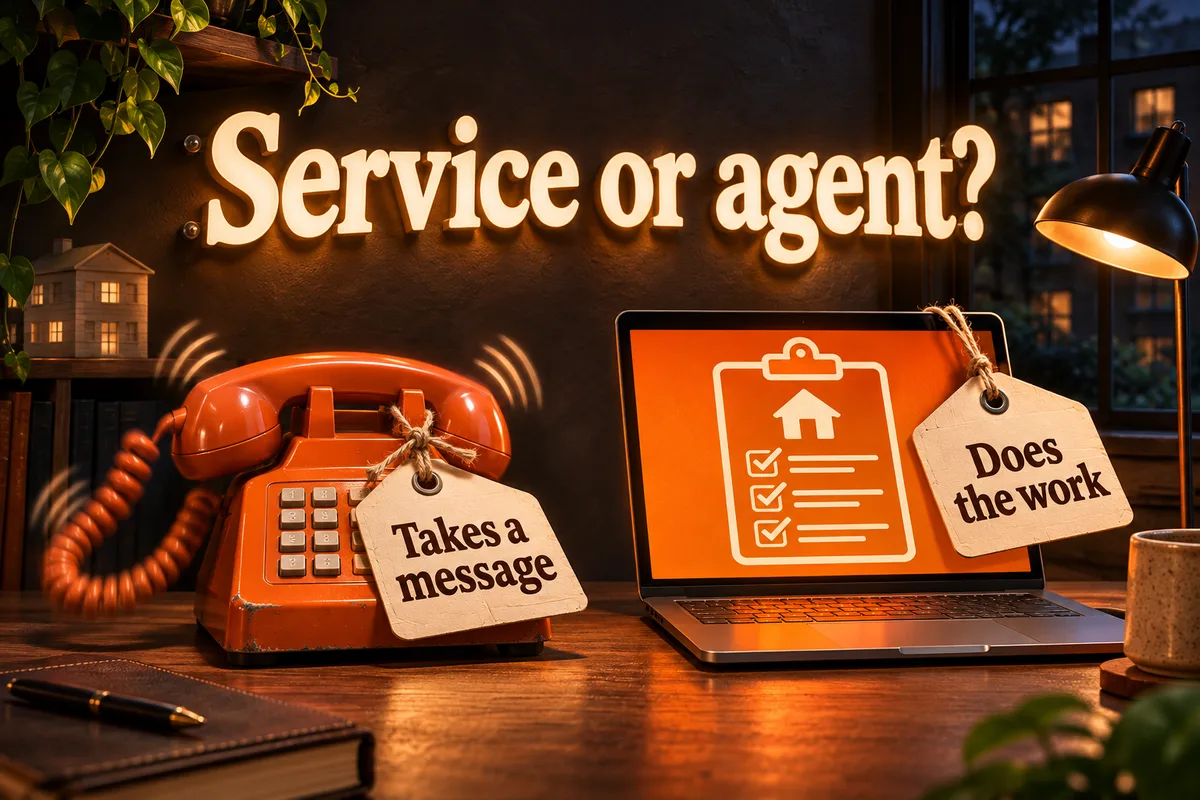
Two tools with similar names and different jobs
The phrases get mixed up in sales calls, so start with plain definitions. An answering service takes a call or a chat and handles it for you. In the older version, a person reads a script and passes the message on. In the newer version, an AI voice does the same job. Either way, the service is the front door: it answers, collects details and routes the result to you or to someone on your on-call list.
An agent is a different thing. It does not need to be a phone voice at all. It reads a message from a resident, compares it with your emergency list and your policy, and produces something you can act on: a classification, a work order, a draft reply and a note on what it could not decide. It works inside your process instead of in front of it. A person still approves anything that has a consequence.
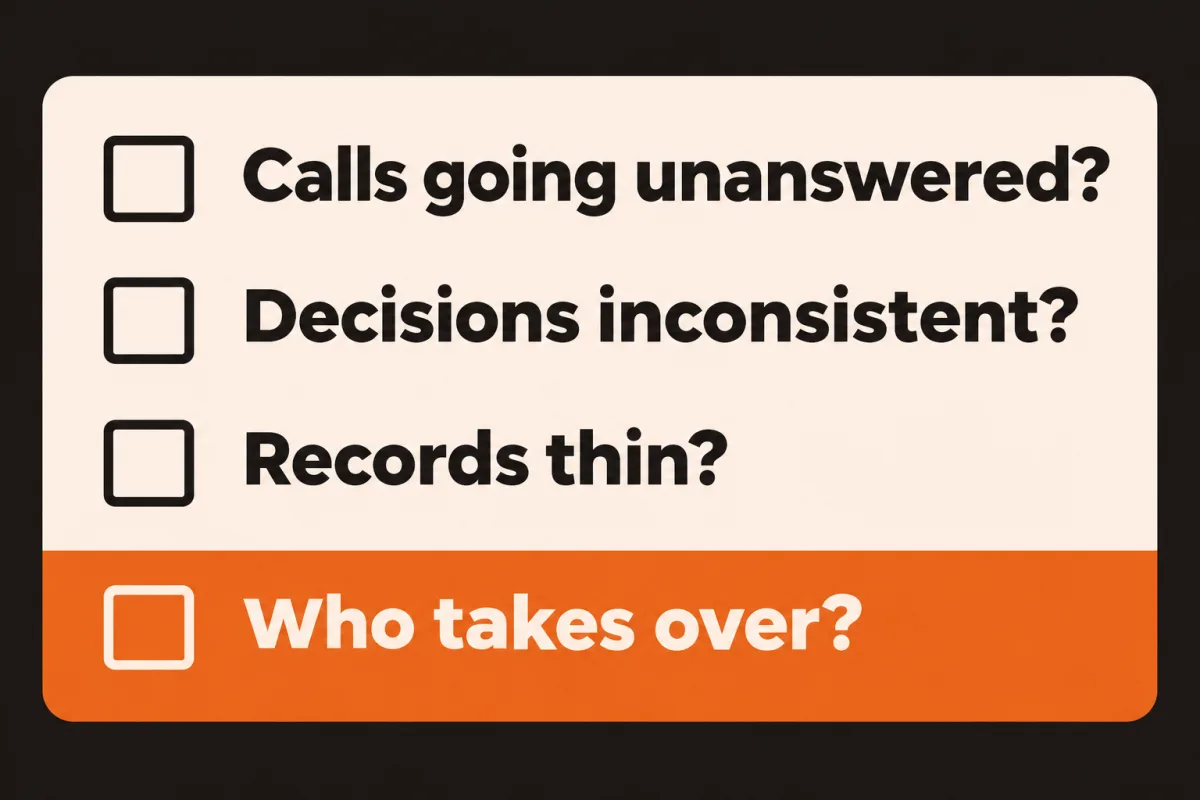
So the useful question is not which one is better. It is which gap you have. If calls go unanswered and residents reach a voicemail at 2 AM, you have a front door problem. If calls are answered but the person on call makes inconsistent decisions, writes thin notes or cannot tell an emergency from a nuisance, you have a decision and record problem. Some offices have both. Most have one that is much worse than the other, and that is the one to fix first. Our after-hours maintenance guide shows where those gaps appear in a normal night.
This is a working comparison, not legal advice. Rules on recording calls, consent to automated or AI voices, disclosing that a caller is talking to an AI, data retention, accessibility and fair housing duties depend on your state and local law and on your lease. Check yours with your own counsel before you turn anything on. Features and terms change, so read each vendor's current documents.
What an answering service does well
A good service answers every call, every time, and does not get tired. That matters more than it sounds. Residents who reach a human, or a clear voice that takes the details, calm down. The call gets logged, the message reaches the right person and the resident knows something is happening. For an office whose main failure is missed calls, nothing else fixes the problem as directly.
A service also takes a weight off staff. If your team rotates on-call duty, a service can absorb the volume of calls that need nothing more than a note, which leaves the person on call for the ones that do. It can cover holidays and weekends without a schedule fight, and it can handle several languages if the vendor offers them. Those are real benefits, and they do not depend on AI at all.
What a service cannot do by itself is decide. It follows the script you gave it. If the script says call the on-call person for any water, it will do that for a dripping faucet and for a burst pipe alike, and your on-call person gets the same call either way. The quality of a service is the quality of your script and the training the vendor gave its staff or its system. The voice on the line does not know your owners, your buildings or your vendors unless you wrote that down for them.
What an AI agent does well
An agent is strongest where a person is weakest at night: consistency. It reads each message against the same list in the same way, and it writes the same kind of note each time. It does not forget to ask whether anyone is in danger, and it does not skip the work order because it is tired. For an office whose problem is inconsistent decisions or thin records, that fixes the right thing.
It also works across channels. A resident can text, email or use the portal, and the agent reads the message the same way. It can draft the reply, create the work order and put the right facts in the right fields: unit, issue, urgency, what the resident has already tried, whether anyone is home. When the on-call person picks it up, they start with a summary, not a voicemail. Our tenant emergency maintenance list is the kind of document an agent reads from.
What an agent cannot do is replace the person who decides. It should flag a possible emergency and prepare the call, and then a person sends the plumber, because that decision spends the owner's money and carries risk. It also depends on what you give it. A vague emergency list produces vague sorting. And if you want a voice that answers the phone, an agent by itself does not do that. You need a voice front end, which is where the two tools meet.
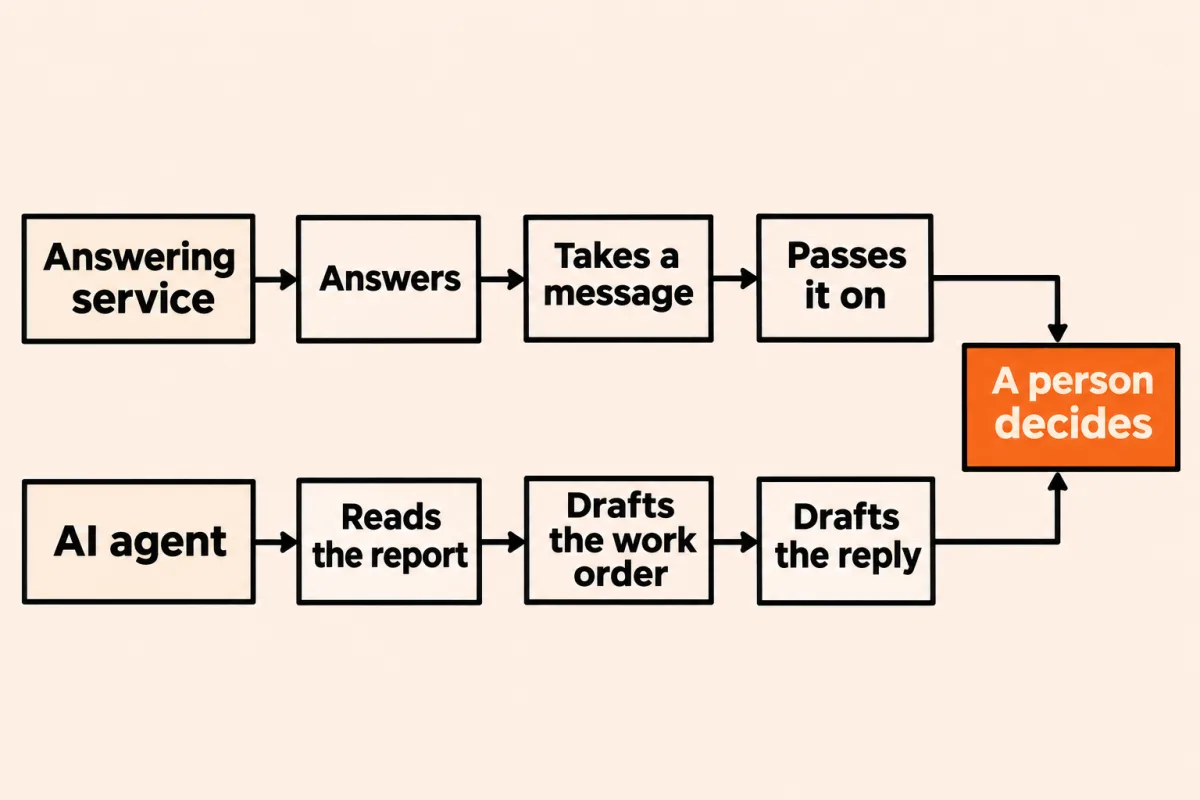
Where each tool sits on a night call
A service owns step two. An agent owns step three. Step four stays with a person.
Side by side
The table below compares them on the points that matter in practice. It does not rank them, because the right answer depends on your gap. Prices are left out on purpose, since they differ by vendor and by volume. Ask each vendor for a written quote based on your own call volume, and compare the same unit of cost across all of them.
| Question | Answering service (human or AI voice) | AI agent |
|---|---|---|
| What does it do first? | Answers the call and takes details | Reads the message and sorts it against your list |
| What problem does it fix? | Calls that go unanswered | Inconsistent decisions and thin records |
| Does it decide whether to send a vendor? | Only by following your script | It recommends. A person decides |
| What does the on-call person receive? | A message, a call transfer or a summary, depending on the vendor | A classification, a draft work order and a draft reply |
| Does it need your policy written down? | Yes, as a script | Yes, as the rules it reads |
| Voice calls | Core feature | Needs a voice front end |
| Where does the record live? | The vendor's system, sent to you | Your work order system and files |
| Main risk | A script that sends everything to a human, or a voice that sounds sure and is wrong | A weak emergency list, or trusting a draft without reading it |
Many offices end up with both: a service or voice front end that answers and collects, and an agent behind it that sorts and drafts. The question is which one you add first, and what each one does when it is unsure. The safe design always ends the same way: when the tool is not sure, it hands the case to a person, and the resident hears that someone is on the way, not a guess.
Questions to ask any vendor before you sign
A demo shows the best call. Ask for the worst one. These questions work for a service, an AI voice or an agent, and the answers tell you more than the feature list does.
What happens when it does not understand? Does it say so and hand off to a person, or does it guess? Ask to hear or see a failure, not only a success. A tool that cannot show you how it fails has not been tested enough.
Who writes the rules, and can you change them? Your emergency list and escalation steps should be yours, in a form you can read and edit. If changing a rule takes a support ticket, you will stop changing rules.
Where does the data go? Calls and messages contain names, addresses and sometimes health details. Ask where they are stored, who can read them, how long they are kept and how you delete them. Our AI policy guide covers what to put in writing.
How does it handle recording and disclosure? Rules on recording calls and on telling people they are speaking with an AI vary. Ask the vendor what it does by default and what you must set up, then confirm it with your counsel.
Can a person take over mid-call? A resident who is frightened should reach a human when they ask, without repeating everything. Test it.
What does it cost at your volume? Ask for the total on your real call count, including overage and extra features, and ask what happens in a busy month. Do not compare a headline rate with a total.
A walkthrough: one night, two setups
Say a resident calls at 11 PM because water is coming through a bathroom ceiling. In the first setup, the office uses an answering service with a script. The service picks up on the second ring, collects the unit, the name and the problem, and the script says any water leak goes to the on-call person. The on-call person gets a message, calls back and decides to send a plumber. Everything worked, and the on-call person was woken for a leak that really needed it.
Ten minutes later, another resident calls about a slow drain. The script says any water call goes to the on-call person. The same message goes out, and the same person wakes up again for something that could have waited. That is the weakness of the script, not the voice.
In the second setup, the office uses an agent on a text channel with a service for calls. The two residents each send a message. The agent reads the first, sees water coming from a ceiling, flags it as a possible emergency, drafts the work order and prepares a reply asking whether the water has stopped and whether anyone is in danger. It reads the second, recognizes a slow drain against the list, drafts a reply that a technician will come the next morning, and puts it in the queue. The on-call person sees one flagged case and one routine one, and acts on the first.
The agent did not send the plumber. A person did, in about a minute, and the file shows what was reported, what was asked and what was decided. The next morning the coordinator finishes the routine job. Neither tool was perfect, but the second setup put the decision where it belongs and left a record. A short drill like this on your own emergency list tells you which gap you have.
Common mistakes
Buying a voice when you needed a decision. If your calls are already answered, a voice adds cost and little else. Look at what your on-call person actually struggles with first.
Letting the tool talk to residents with no human path. A resident in a real emergency needs a person quickly. Make the handoff obvious and test it before you go live.
Skipping the emergency list. Both tools depend on it. Without a written list of what counts as an emergency, a service sends everything and an agent guesses.
Promising arrival times through the tool. Neither a service nor an agent controls the vendor. A message that says someone will be there in an hour creates a promise you may not keep.
Never checking the output. Read a sample of calls and drafts every week for the first month. The failures show up in the details.
How to adapt it
A small portfolio with a single on-call person may need neither one yet. Start with a written emergency list and a clear after-hours number, then add a service if missed calls hurt. For a mid-size firm with a rotating on-call, the sorting and the record tend to pay off first, so try an agent on messages before you buy a voice. For a large portfolio with high night volume, a service for calls plus an agent for sorting is the more common pairing, with a person on call for the cases the tools flag.
Think about your residents too. If many speak a language other than English, check what each tool supports and have a person who can review it. If a resident has a disability that makes phone calls hard, make sure a text option exists, and check your accessibility duties with your counsel. If your property has a front-desk team during the day, the daytime flow can use the same agent for sorting messages.
Check your software before you buy anything new. AppFolio, Buildium, DoorLoop and Rent Manager each ship some form of AI or messaging feature, and they may cover part of this. Our best AI tools for property managers guide and the AI features comparison show what is already in the tools you pay for, so you buy only the gap.
Where AI helps and where a person decides
AI can help you make this decision before you spend anything. Paste a month of after-hours notes with names removed into ChatGPT or Claude, and ask how many calls were unanswered, how many were sorted the same way twice, how many records lacked key facts and how many needed no action at night. The answers show you whether you have a front door gap or a decision gap.
A person decides what to buy, what to automate and what the tool is allowed to say to a resident. The tool should never decide whether to dispatch, never state a legal rule and never promise an arrival time. Treat anything it drafts as a draft, and keep personal details of residents out of any tool your firm has not approved.
Below are after-hours notes from the last [period], with names and unit numbers removed. For each entry, tell me: (1) was the call or message answered in time, if the notes say; (2) was it a real emergency by our list, which is pasted below; (3) did the notes record what the resident reported, what was decided and who decided; (4) was the on-call person woken for something that could have waited. Then summarize in five lines whether our main gap is unanswered calls, inconsistent sorting or thin records, and name the evidence in the notes. Do not recommend a vendor. If a field is missing, write MISSING. [paste emergency list, then notes]Check the counts against the notes before you rely on them. If the gap is sorting and records, the After-Hours Maintenance Agent is a low-risk place to start, because it drafts and a person decides.
Before you buy or switch on anything
- You know your main gap: unanswered calls, inconsistent sorting or thin records.
- Your emergency list is written down and the tool reads from it.
- A person can take over at any point, and you tested it.
- You know where calls and messages are stored and how long they are kept.
- Recording and disclosure rules have been checked with your own counsel.
- You will read a sample of calls and drafts every week for the first month.
Questions
What is the difference between an answering service and an AI agent?
An answering service picks up calls and takes details, by a person or an AI voice. An agent reads a message, sorts it against your emergency list and prepares a work order and reply. A person still decides whether to dispatch.
Do property managers need an AI answering service?
Only if unanswered calls are your main problem. If calls are answered but decisions are inconsistent or records are thin, an agent that sorts and drafts may fit better. Many firms eventually use both.
Can an AI answering service handle maintenance emergencies?
It can take the details and route the call. Whether to send a vendor is a decision for your on-call person, based on your written emergency list.
What should you ask an AI answering vendor?
What happens when it does not understand, who writes the rules, where the data is stored, how recording and disclosure are handled, whether a person can take over mid-call, and the total cost at your call volume.