
Why the return letter goes wrong
A resident has moved out. They want their money back, they may need it for the next deposit, and they are watching the mail. On your side, the move-out inspection is done, the vendor invoices may still be coming in, the owner has opinions, and the file sits on someone's desk while other work takes over. The deadline does not wait for any of that.
Most return problems are simple. The letter goes out late because someone waited for one last invoice. It leaves out the forwarding address check, so it goes to the old unit and comes back. It lists a deduction with no invoice or photo behind it, so the resident disputes it and the file cannot answer. Or it uses a vague line like "cleaning and repairs" with a single number, which tells the resident nothing and tells a judge less.
The letter is a legal document in everything but name. Treat it as one. It states what you held, what you spent it on, why, and what you are sending back, and it does so within a window the law may set. A calm, complete letter ends most deposit conversations. A hurried one starts them.
This is a working template, not legal advice. Deadlines for returning a deposit, what the letter must itemize, whether interest is owed, what happens to a deposit if you miss a deadline, how to deliver the letter and what you may deduct all depend on your state and local law and on your lease. Check yours with your own counsel before using it.
The deadline, and why you cannot guess it
Every state that regulates deposits sets some kind of timeline, and the length, the starting point and the penalty for missing it vary a great deal. Some count from the day the resident moves out. Some count from the day you receive the keys or the forwarding address. Some give you extra time if you itemize deductions and less if you return the full amount. Some penalize a late return by making you forfeit the right to deduct, or by exposing you to a multiple of the deposit.
That is why the deadline belongs in your process, not in your memory. Look it up once, with your counsel, for every state you operate in. Write the number of days and the starting event on one line at the top of the move-out file. Then set a task for a date well before the deadline, because the letter itself takes days to prepare once you count inspections, invoices and the owner's sign-off.
If the unit sits in a city with its own rules, check those too. Some cities add requirements on top of the state, such as a specific form, an inspection offer or a receipt. And read your lease, because it may promise the resident something stricter than the law does. Our move-out checklist shows where the clock starts in a normal move-out.
What the letter has to carry
Rules differ on form, but most return letters carry the same core facts. Build the template around them and let your counsel add whatever your state requires, such as specific wording, a statutory notice or a form.
| Part of the letter | What it says | Where it comes from |
|---|---|---|
| Who and what | Resident names, the unit address, the lease dates and the move-out date | Lease and move-out record |
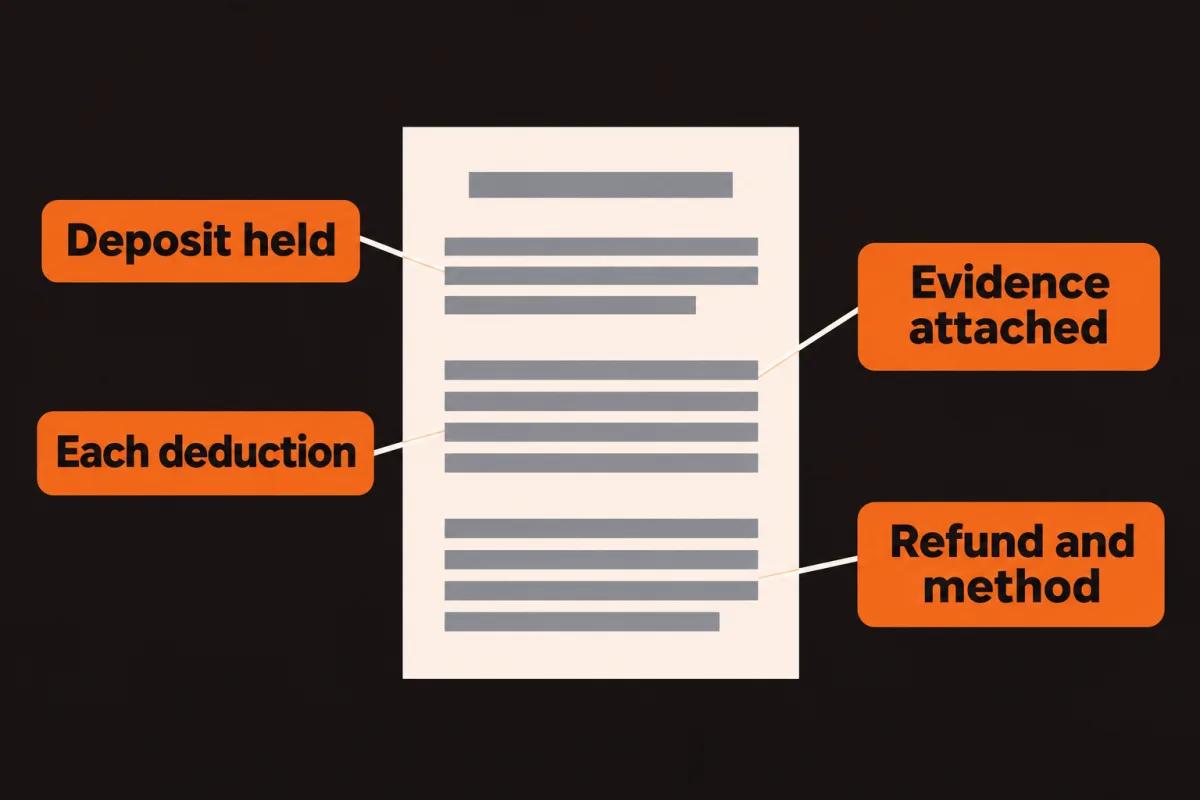
| Deposit held | The amount you received, and any interest if your state requires it | Ledger |
| Deductions | Each item on its own line with the reason and the amount | Inspection, photos, invoices |
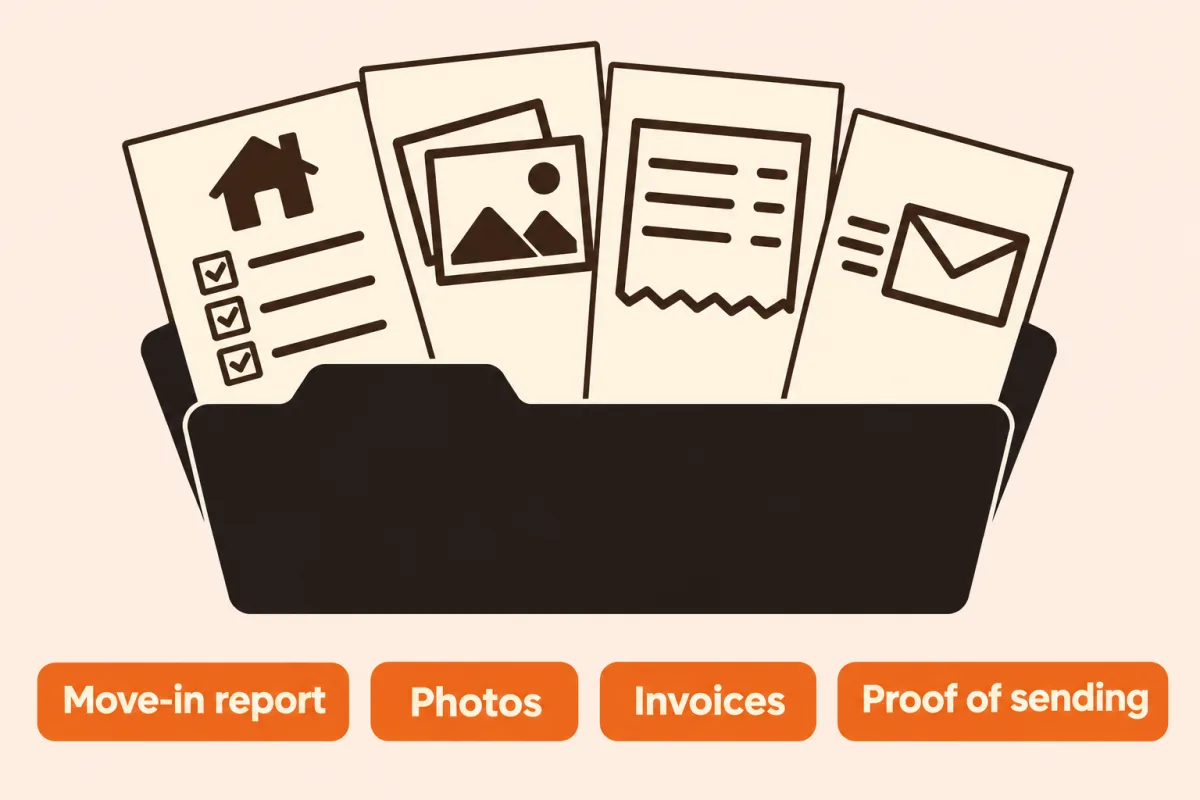
| Evidence | What is attached: itemized invoices, photos, the move-in and move-out inspection | Move-out file |
| Amount returned | The balance, how it is sent and to which address | Ledger and payment record |
| Contact | Who to call with a question and how to dispute an item, if your rules say so | You |
Two pieces trip people up. The first is the evidence. A deduction without a document behind it is an opinion. If the carpet needed replacing, the file should have the move-in condition, the move-out photo, the age of the carpet and the invoice. If a deduction is a share of a cost, the letter should show how you calculated it. The second is the address. Use the forwarding address the resident gave you in writing, and if they gave none, use the method your lease and local law describe. Record what you sent and where.
Whether an item counts as damage or as ordinary wear depends on the facts and on your law. Our security deposit deduction letter guide goes deeper on how to word a charge. This guide covers the whole return, including the case where there are no deductions at all.
Deposit return, from keys to mailbox
Count back from the deadline at the first step. The send date is the one that matters.
Two templates: full return and return with deductions
Most returns are one of two shapes. When the unit is clean and in normal condition, the letter is short and warm. When there are deductions, the letter grows into a statement, and every line needs a source. Use the first when you can and the second only with the documents in hand. Change anything your counsel or your state requires, and remove anything that does not apply.
Your security deposit for [address]: full return
Dear [resident name(s)],
Thank you for living at [property]. Your lease ended on [date] and you returned the keys on [date]. We held a security deposit of [amount]. After the move-out inspection on [date], we found no deductions. We are returning [full amount, plus any interest required] by [method] to [address], sent on [date].
If you have a question, contact [name, phone, email].
Thank you,
[name, company]
Your security deposit for [address]: return with deductions
Dear [resident name(s)],
Your lease ended on [date] and you returned the keys on [date]. We held a security deposit of [amount] [and interest of [amount], if required]. After the move-out inspection on [date], we are making the deductions below. Photos, the inspection report and invoices are attached.
[Item 1]: [short reason, with reference to the move-in and move-out condition]. [Amount].
[Item 2]: [reason]. [Amount].
Total deductions: [amount]. We are returning [balance] by [method] to [address], sent on [date].
[Any statement or notice of rights your state requires.] If you have a question about any item, contact [name, phone, email] by [date, if your rules give one].
Thank you,
[name, company]
A walkthrough: one return with a deduction
Say a resident moves out of a one-bedroom apartment at the end of a lease. The coordinator notes the deadline for the state at the top of the file and sets the task for three days before it. The resident gave a forwarding address on a move-out form, which is saved in the file.
The maintenance team does the inspection the next day, with the move-in report open beside them. The unit is clean, except for a burn mark on the counter and a missing screen. The photos match the report, and the move-in report shows both were fine at the start. A vendor quotes for the counter and the screen, and the owner approves the work.
The invoices arrive before the deadline, which does not always happen. The coordinator drafts the letter with two lines, each one with the reason, the amount and the invoice number. The owner reviews the amounts. The coordinator checks the letter against the state checklist from counsel, adds the required notice, and sends the letter and refund together by the method the lease describes. A copy of the letter and the proof of sending go in the file.
If an invoice had not arrived in time, the coordinator would not have waited and guessed. They would have asked counsel what the state allows for a late invoice, and sent a letter on time with what was known, if the rules permit. That decision is a person's. If you want to see how a similar file looks from the resident's side, the welcome letter sets expectations at the other end of the lease.
Common mistakes
Waiting for the last invoice. If the deadline is close, the letter goes out on time. Ask counsel how your state treats an estimate or a late invoice, and decide in advance.
Writing one lump sum. "Cleaning and repairs, a single amount" invites a dispute. Itemize each charge with its reason and evidence.
Charging for normal wear. Many places do not let you deduct for ordinary use over time. A faded paint job or worn carpet after a long tenancy is a common example. Ask counsel where the line is, and write the line into your policy.
Using the wrong address. The letter that goes to the old unit and comes back creates a second deadline problem. Confirm the forwarding address in writing at move-out, and keep the method of delivery in the file.
Letting the owner decide the deductions alone. The owner has an interest, but the letter carries your name and your license. Review each charge against the evidence before it goes out, and say no to one the file cannot support.
Forgetting to keep the file. Keep the letter, the proof of sending, the photos and the invoices for as long as your counsel says. The file is what you rely on if the resident disputes an item.
How to adapt it
For a single-family house, the move-out inspection often has more rooms and more outdoor items, such as a yard, a fence or a garage. Add those to the checklist. For multifamily, the volume is the problem. Keep a standard inspection form and a standard letter, and spend your attention on the exceptions. For a unit with a roommate lease or a co-signer, check how your lease and your law treat who receives the deposit and who must be named.
If the deposit was held in a trust account or by an owner, make sure the refund comes from the right source and the ledger matches it. If the deposit also covers last month's rent, unpaid utilities or a pet, the letter has to show that arithmetic. AppFolio, Buildium, DoorLoop and Rent Manager each have a deposit accounting or move-out workflow, so use the one in your software to record the refund, and attach the letter to the resident record.
A resident who disputes an item deserves a calm, written reply that points to the evidence. Where the evidence is weak, consider whether the charge is worth defending. Where it is strong, answer with the photo and the invoice and a contact. A dispute that ends in two emails is cheaper than one that ends in a hearing. The same habit helps on the front end: the rent increase notice and the lease renewal letter are cleaner when your file is cleaner at move-out.
Where AI helps and where a person decides
AI is useful for the assembly work. Give ChatGPT or Claude the ledger balance, the move-in and move-out notes, the invoice details and your approved template, and it can draft the letter, line each charge up with its evidence and flag any line that has no document behind it. It can also write the short refund-only letter and a polite reply to a dispute.
A person decides the legal and financial parts. The deadline, the required wording, whether a charge is wear or damage, how much to deduct and whether to deduct at all are decisions for you and your counsel. Do not let the tool quote a state rule or fill in a deadline. If you did not give it, the draft should say MISSING. Use resident names and addresses only in a tool your firm has approved.
Using only the lease details, ledger balance, move-in and move-out inspection notes, and invoices below, draft a security deposit return letter using the approved template in this Project. List each deduction on its own line with the reason, the evidence it relies on (photo, report line or invoice number) and the amount. If a deduction has no evidence in the material, do not include it; list it separately under NEEDS EVIDENCE. Calculate the balance to refund. Do not state any legal deadline, rule or required wording; put MISSING where the template asks for them. [paste material]Check each line against the file and the amounts against the ledger before it goes out. The Security Deposit Agent does the same cross-check from your move-out folder.
Before you send the return
- The deadline and starting event for your state are written at the top of the file, and you are inside it.
- Every deduction has a reason, an amount and a document behind it.
- No charge covers ordinary wear, as your counsel defines it.
- The wording and any required notice match what your counsel gave you.
- The forwarding address and the delivery method are right.
- You kept a copy of the letter, the proof of sending and the evidence.
Questions
How long do you have to return a security deposit?
It depends on your state, and sometimes your city and lease. The length and the starting event vary, so look it up with your counsel and put it at the top of every move-out file.
What should a security deposit return letter include?
Resident and unit details, the deposit amount, each deduction with its reason and amount, the evidence attached, the refund amount and how it was sent, and a contact. Add any wording your state requires.
Can a landlord deduct for normal wear and tear?
Many places do not allow it. What counts as wear and what counts as damage depends on your state and the facts, so check your policy with your own counsel.
Can AI write a security deposit return letter?
It can assemble a draft from your ledger, inspection notes and invoices, and flag charges with no evidence. A person confirms the deadline, the wording and every deduction.