
Why vetting matters more than the fee
Owners usually compare managers on the fee, because it is the one number printed on every proposal. It is also the number that tells you least. A manager who is cheap and loses you a month of rent on every turnover costs more than one who is careful and charges a bit extra. A manager who holds your money badly can cost you far more than any fee. If you run the management side, the same questions work in reverse in our owner communication guides, and the free Owner Statement Agent drafts the kind of monthly report this guide tells owners to ask for.
The work you are handing over is wide. The manager finds residents, screens them, writes the lease, collects rent, deals with repairs, hires vendors, holds deposits, handles notices and reports to you. Each of those is a place where a careless person can cost you money or put you in legal trouble, and most of it happens out of your sight. You find out through a statement, a complaint or a bill.
That is why vetting is worth the time. You are not checking whether the manager is a good person. You are checking whether they have a process that works when they are busy, when a vendor fails and when a resident disputes a charge. This guide gives you a way to do it. If you are weighing the money side first, our rental cash flow worksheet shows where a management fee sits among the other lines. To see the numbers the manager should be reporting, use a rental cash flow worksheet as your own check.
This is general information, not legal advice. Licensing rules, trust account requirements, management agreement terms, deposit handling and fair housing duties depend on your state and local law. Check what applies to you, and have your own counsel read a management agreement before you sign it.
Start with what you can verify
Before you ask a single question, check the facts that do not depend on anyone's word. Many places require a manager, or the person who supervises one, to hold a license. Look up the requirement for your location with the state or local authority that handles it, then check that the license is current and in the name of the company or person you are dealing with. Rules differ widely, so do not assume what your last city required. Credentials are one signal, not proof. IREM offers the Certified Property Manager (CPM) credential and NARPM offers the Residential Management Professional (RMP) designation, so ask a manager which they hold and check it with the issuer.
Look for the business itself. A real company has a registered name, an address, a phone line that gets answered and a website that matches what the proposal says. Check for complaints in places where complaints are recorded, and read recent reviews from owners, not only residents. A few bad reviews from residents are normal, because residents are sometimes angry for good reasons and sometimes not. A pattern of owners saying their money was late, their statements were wrong or nobody called back is a different matter.
Ask for proof of insurance, and read what is covered. A manager commonly carries liability coverage and may carry coverage for errors and omissions and for employee dishonesty. You want to know what exists and who is named on it, and your own counsel or insurer can tell you what you should expect. Ask whether you will be named as an additional insured where that makes sense.
Documents to request before you sign
A manager who runs a tidy operation can hand these over quickly. One who cannot is giving you information too.
The management agreement, in full. Not a summary. Read the term, how either side can end it, what happens to deposits and records on exit, which fees apply and when, and who pays for what. A management agreement with an unclear fee list is a warning.
A sample owner statement. You want to see how income and costs are laid out, whether repairs show the vendor and invoice, and whether fees are on separate lines. Our owner statement guide explains what a clear one contains.
The fee schedule. Every charge, including leasing, renewal, inspection, maintenance markup, setup, termination and any fee for work order coordination. Ask what is included in the monthly fee and what is billed on top.
The approval limit policy. What the manager can spend without asking you, and how fast you hear about anything above it. Our guide on telling an owner about an expensive repair shows what a good message looks like.
A sample lease and resident screening criteria. The lease should be the kind your counsel would recognise as current for your state, and the screening criteria should be written down and applied the same way every time, which is also a fair housing matter.
Questions that separate careful managers from careless ones
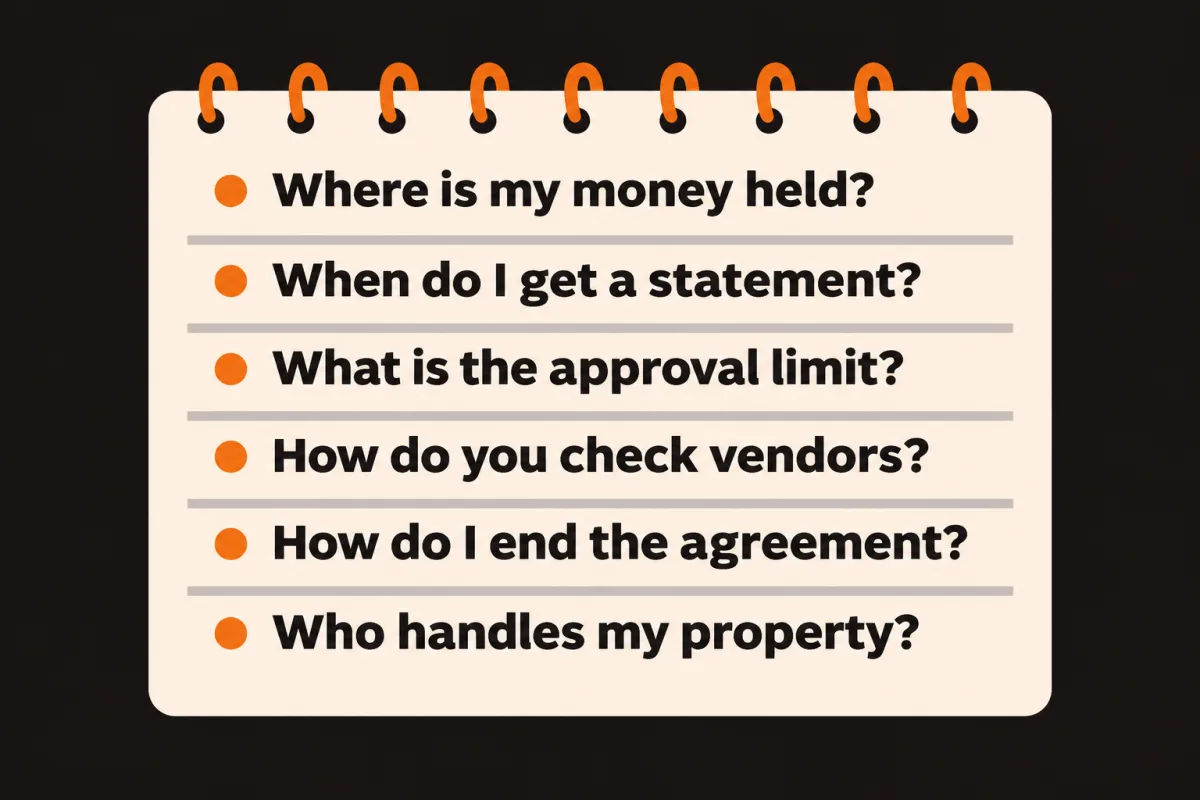
Ask the same questions of every candidate, and write the answers down. The best signal is not whether they know the answer. It is whether they can show you the process behind it.
Where is my money held, and how do I see it? Rent and deposits should sit in accounts set up for the purpose, kept apart from the manager's own operating money, in line with the rules where you are. Ask how often accounts are reconciled and whether you can see the records.
When do I get paid, and when do I get a statement? A manager should be able to name the day of the month for each. Ask what happens when a resident pays late.
What happens when a repair costs more than the limit? Listen for a process, with a quote, a message to you and a time you can respond. Listen for what happens if you cannot be reached and the problem is urgent.
How do you choose and check vendors? Look for licensing and insurance checks, more than one bid on larger jobs and a record of how each vendor performs. A vendor scorecard is the kind of tool a manager with a real process keeps.
How do you handle an eviction or a dispute? The answer should involve counsel, written notices and a record. It should not involve improvising.
Who will actually manage my property, and how many do they handle? A person with a very large list cannot give each owner much attention. Ask how work is split, who covers when someone is out and who answers after hours.
Can I talk to two current owners and one who left? A confident manager will provide references. One who leaves a gap here is telling you something.
How to vet a manager
Do the checks in this order. Each one is cheaper than the mistake it prevents.
Red flags
Some signals are worth walking away over. A manager who will not show you the agreement before you commit, or who rushes you to sign, is protecting something. A manager who cannot explain where deposits and rent are held is a risk to your money. A fee structure that is hard to describe, with many small charges in different places, tends to produce a statement you cannot read.
Be careful with guarantees. A promise of full occupancy, a fixed rent or a result nobody controls is a sales line, not a service. Be careful with a manager who criticises every other manager and offers no process of their own. Be careful when the person who sells to you is not the person who will run the property, and nobody will say who that is.
Last, notice how the manager treats you before you hire them. Slow replies, vague answers and missed callbacks during the sales stage will not improve after you have signed. How a company behaves when it wants your business is the best case.
A scorecard you can copy
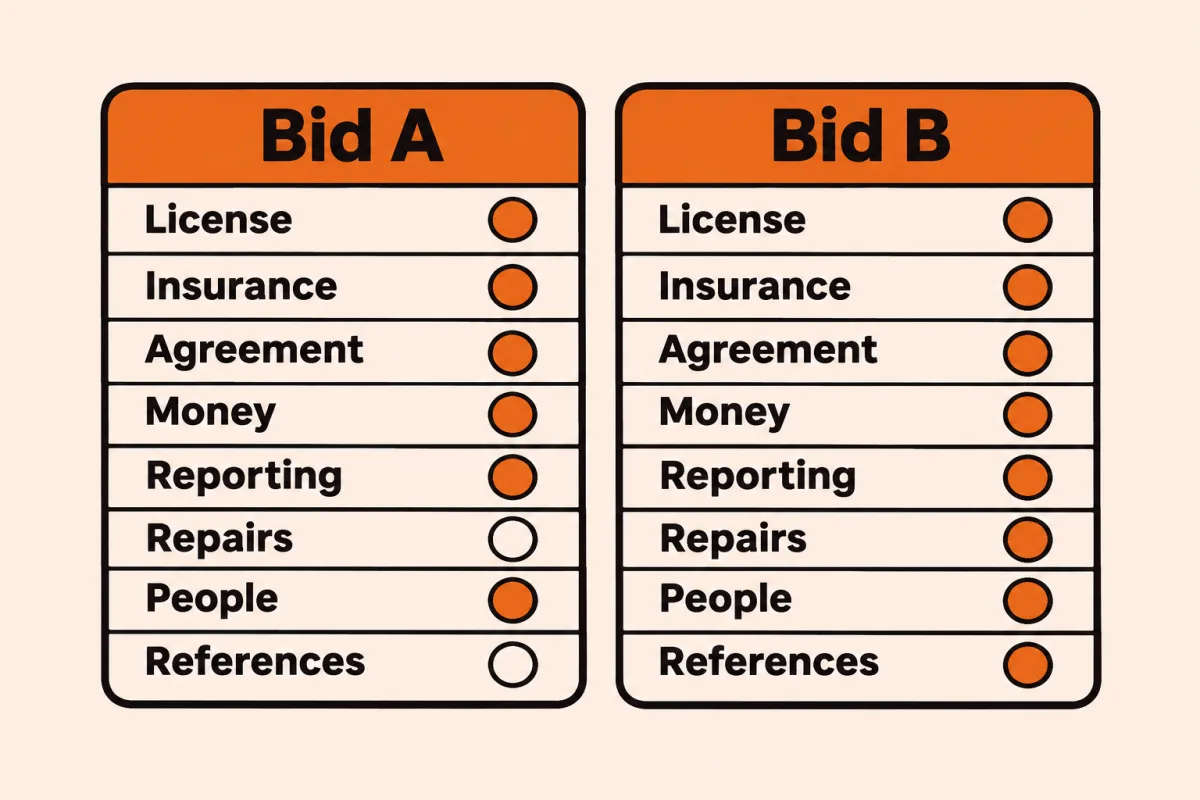
Use the same scorecard for every candidate and fill it from documents and answers, not from the feeling in the room. Score each line as clear, unclear or missing, and add a note. Leave blank anything you did not check.
| Area | What to look for | Clear, unclear or missing |
|---|---|---|
| License and business record | Current license where required, registered business, real address | [ ] |
| Insurance | Proof of coverage and who is named | [ ] |
| Agreement | Term, exit, fees, deposits and records on exit | [ ] |
| Money handling | Separate accounts, reconciliation, payment day, statement day | [ ] |
| Reporting | Sample statement with fees and invoices on separate lines | [ ] |
| Repairs | Approval limit, quotes, vendor checks, urgent process | [ ] |
| Screening and leases | Written criteria, current lease, same treatment every time | [ ] |
| People | Named contact, workload, coverage, after-hours number | [ ] |
| References | Two current owners and one former, all reachable | [ ] |
A walkthrough: comparing two bids
Say an owner is moving out of town and needs a manager for a small rental house. Two companies send proposals. The first has a lower monthly fee and a short agreement. The second has a higher fee and a long one. The owner uses the steps above and does not decide by the price.
She checks both licenses and finds the first company's is current and the second company's is held by the supervising broker, which the second company explains without being asked. She asks for the full agreements. The first lists a fee for each repair visit and a fee to end the contract. The second lists a flat monthly fee, a leasing fee and a renewal fee, and spells out how deposits are returned if she leaves.
She asks both where rent is held and when she is paid. The second manager names the dates and offers to send a sample statement the same day. The first says it depends and promises to send something later. She calls two current owners for each company and one former owner for the second. The second company's references describe the monthly statement in similar words. The first company's only reference is a friend.
When she puts the two scorecards side by side, the second company has more clear boxes and none missing. The fee is higher, and the real cost of the first, once repair visits and exit fees are added, is not lower. She has her counsel read the second agreement before she signs. The decision took a few evenings and was made on evidence.
Common mistakes
Choosing on the fee alone. Add every charge from the schedule and compare the total on the same property. The cheapest line is not the cheapest contract.
Skipping the agreement until after the pitch. Read it before you commit. The sales conversation is friendly, and the document is what binds you.
Never calling a reference. People are often more candid than you expect, especially a former client. Ask what went wrong and how it was handled.
Not asking about exit. Know how to end the agreement, what it costs and how deposits, keys, records and resident information move to the next manager.
Assuming the salesperson is the manager. Ask who will handle your property day to day and meet that person if you can.
How to adapt it
If you own one house, you can run the whole process in a few evenings and the scorecard fits on one page. If you own several properties or a small building, ask each manager about experience with that property type, and ask how they handle shared systems and multiple units. If you live far from the property, put more weight on reporting and photos, because you cannot look in yourself.
If you already have a manager and you are unsure, the same questions work as a review. Ask for the documents again, compare your recent statements with the scorecard and have a direct conversation about anything unclear. The owner onboarding checklist shows what a good start with a manager looks like, and you can compare it with your own.
Where AI helps and where a person decides
AI is good at organising what you collect. Paste the answers and documents from each candidate into ChatGPT or Claude, with personal details removed, and ask it to fill your scorecard, list the fees side by side and flag anything the agreement leaves unclear. It can draft the list of questions for a reference call and summarise a long agreement into the clauses you should ask your counsel about.
A person decides who to trust. A model cannot verify a license, call a reference or tell whether a manager is evasive. It will not know your state's rules, and it should not tell you an agreement is safe to sign. Keep the legal read with your counsel and the final choice with you.
Below are notes and documents from [number] property management candidates for my [property type] in [city]. For each candidate, fill this scorecard: license and business record, insurance, agreement terms, money handling, reporting, repairs and approval limit, screening and leases, people and coverage, references. Mark each line CLEAR, UNCLEAR or MISSING based only on the text. List every fee in a table with when it is charged. List clauses in each agreement about ending the contract and what happens to deposits and records. Do not recommend a candidate and do not say whether an agreement is safe. [paste notes]Check each answer against the source. Then hand the agreement you prefer to your counsel. If you also want to know what you should receive month to month, see the owner update email template, and browse the agents managers use to draft them.
Before you sign
- The license, business record and insurance are checked against official sources.
- You read the full agreement and the fee schedule, and you can say how to end it.
- You know where rent and deposits are held, and the payment and statement days.
- You saw a sample owner statement.
- You called two current owners and one former one.
- You know who will manage your property day to day.
- Your own counsel read the agreement.
Questions
How do I vet a property manager?
Verify the license, business record and insurance, read the full agreement and fee schedule, ask every candidate the same questions, call references and score each one on the same sheet.
What should I ask a property manager before hiring?
Where rent and deposits are held, when you are paid and get a statement, what the approval limit is, how vendors are checked, how disputes are handled, who manages your property and how to end the agreement.
What are red flags in a property manager?
Refusing to share the agreement, rushing you to sign, unclear fees, no clear answer on where deposits are held, guaranteed results and no references.
Can AI help me compare property managers?
It can organise answers into a scorecard, list fees side by side and flag unclear clauses. You verify the facts, call the references and have counsel read the agreement.