
Why repeat late payers are a different problem
The standard late rent sequence assumes a surprise. A resident forgot, or a paycheck came late, or a bank transfer got stuck. You send a friendly reminder, the money arrives, and the account is clean. That sequence works, and our late rent guide lays it out stage by stage.
A resident who pays on the eighth every month is not in that situation. They are not surprised, and a reminder on the second does not change anything because they already know. Each late payment may be small, and your fee may be paid, so no single month looks like a crisis. But the pattern costs you. Staff time goes into the same follow-up every month. The owner gets the money late, which can affect their own bills. And the habit tends to grow, because nothing about the pattern has ever been addressed.
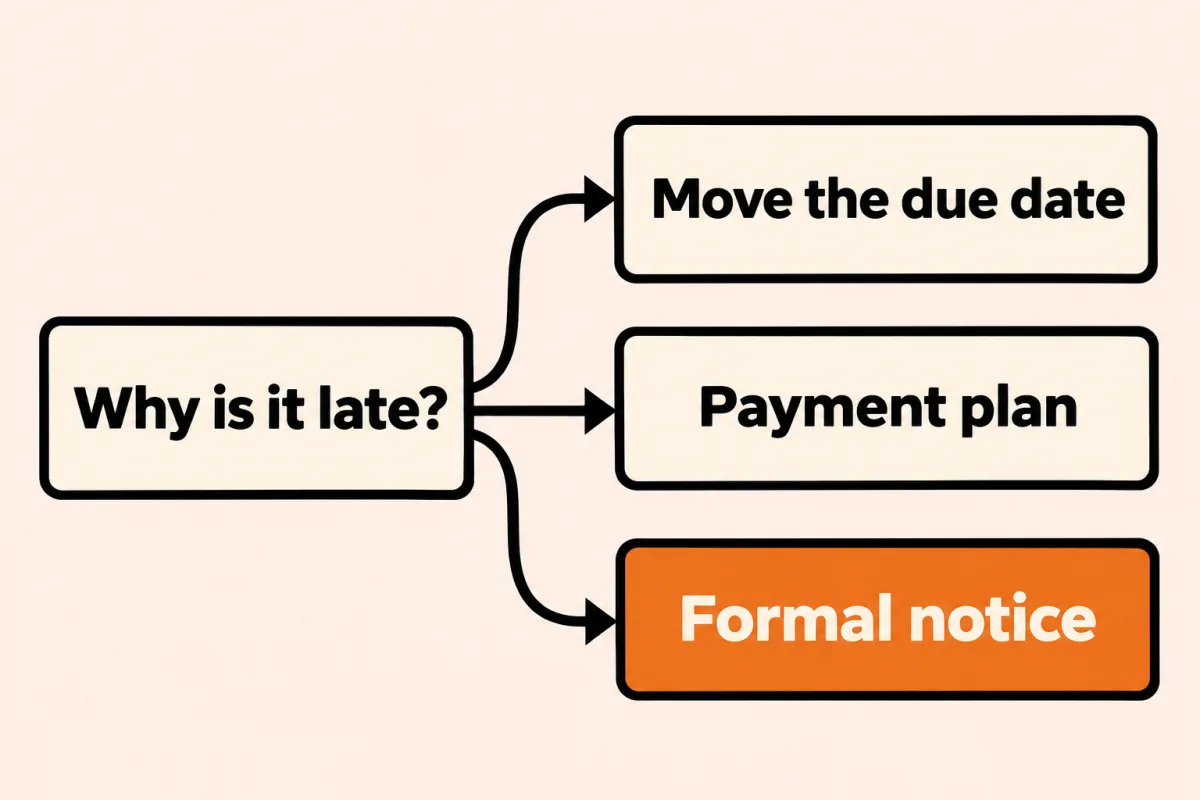
The mistake is to keep treating a pattern as a series of accidents. The other mistake is to jump straight to a harsh response because you are tired of it. Both skip the useful step, which is to find out why the payment is late. A resident whose paycheck lands on the fifth has a calendar problem, and you can often fix it. A resident whose income dropped has a money problem, and a payment plan or a referral may help. A resident who simply does not prioritize rent has a different problem, and the lease and the law give you the tools for that. Each one needs a different message.
This is a working guide, not legal advice. Grace periods, late fee limits, what you may accept as partial payment, notice requirements and what counts as a lease violation depend on your lease and on state and local law, and some places restrict action on repeated late payment. Check yours with your own counsel before acting on any of it.
How to tell a pattern from a slip
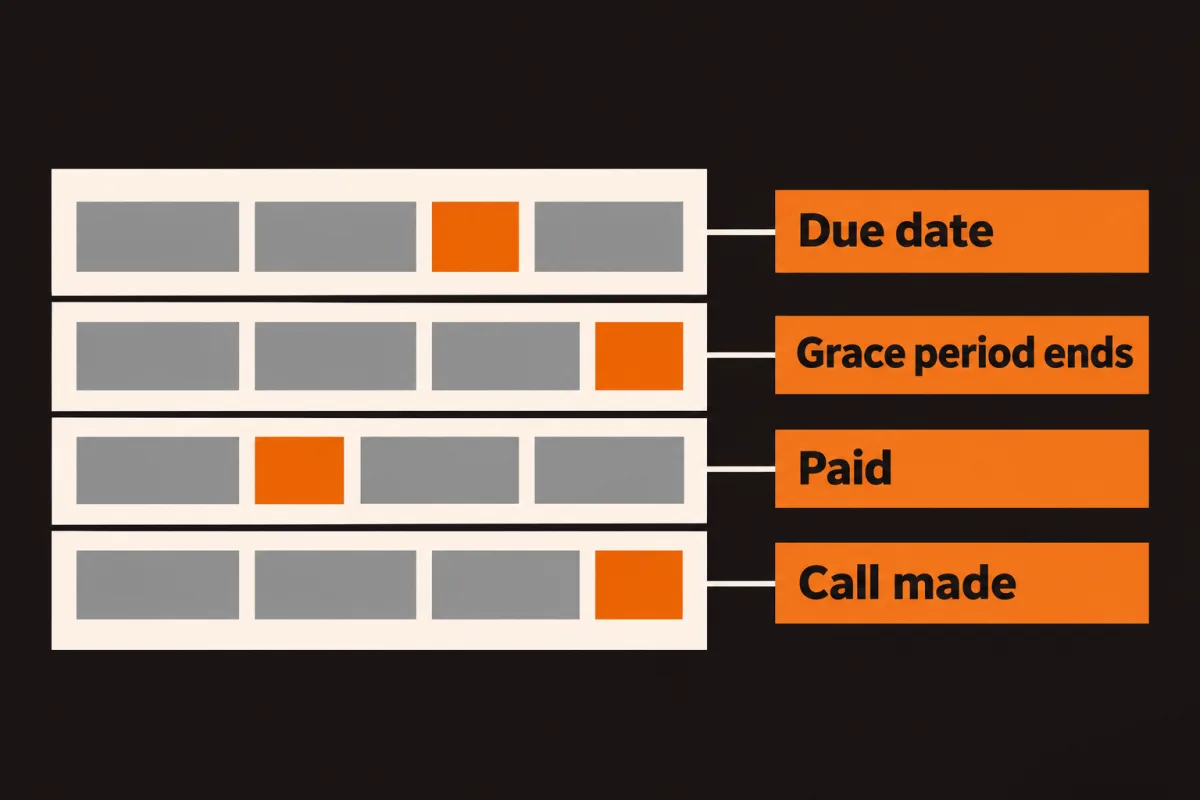
Look at the ledger, not at your memory. People remember the angry call and forget the three quiet payments. Pull the payment history for the past year and mark the day each rent arrived against the due date and the end of any grace period. You are looking for one thing: is the lateness consistent?
Consistency matters more than the size of the delay. A resident who is late by the same few days every month, always after the same date, is telling you something about their pay schedule. A resident who is late in one month, early in the next and very late in a third is telling you something else. The first group is easier to help. The second often has an income or budgeting problem that a date change will not fix.
Also check what else is going on with the resident. Have they had a long maintenance problem you were slow to fix? Did their household change? Did they ask for something and never hear back? Some late payments are a quiet protest. You will not know until you ask, but you can see the signs in the file before you call.
| What the ledger shows | What it often means | First move |
|---|---|---|
| Late by about the same amount every month, same day each time | The resident is paid after your due date | Ask about their pay schedule and what the lease allows |
| Late in some months, on time in others, no clear date | Irregular income or tight budget | Ask directly, and look at a payment plan |
| Paying in parts, or paying the fee but not the rent | The resident is short and prioritizing | Talk before the balance grows |
| Was reliable, then late for the last two or three months | Something changed: job, health, household, or a grievance | A personal call, not a form letter |
| Late for a long time with no explanation, ignores messages | A resident who is avoiding you | Written notice per your lease, after counsel confirms the step |
The conversation that finds the cause
Call or meet the resident, in that order of preference, and keep the first conversation short and kind. You are not there to accuse. You are there to say you have noticed that the payment has come after the due date for several months in a row, and to ask what is happening. Say it in a way that makes it easy for the resident to answer honestly. Residents tend to be more honest when they do not feel they are being set up for an eviction.
Listen for the cause. A resident who says their employer pays on the fifteenth and the first is impossible is giving you a precise answer. A resident who goes quiet, or says things have been hard, is telling you to move to a different conversation. A resident who is angry about an unrelated problem is telling you to fix that problem or at least acknowledge it. You do not have to solve the cause on the call. You do have to hear it, write it down and say what happens next.
Follow every call with a short written note that records what was said and what you agreed. If the resident asks you to change something, say what you can do and what you need to check. Avoid promising anything on the call that your lease, your owner or the law might not allow. It is easier to say "let me confirm and get back to you by Friday" and keep that promise than to retract a yes.
From pattern to plan
Skip step three and every option after it is a guess.
The options, and when each one fits
You usually have four paths, and they are not exclusive. Think of them as a ladder you climb only as far as you have to, with a person making each decision.
Align the due date with the pay date. If the resident is consistently late because of when they are paid, ask whether your lease or your owner allows a different due date or a different payment schedule. Many leases do not, and an owner may not want one resident on a different calendar, so this is a request you check before you promise. Where it is allowed, it removes the cause. Where it is not, a reminder timed to the resident's pay date can help, and so can setting up automatic payments on the day after payday if your portal supports it.
A payment plan. If the resident has fallen behind and has a credible way to catch up, a written plan can give them room while protecting you. Our rent payment plan template covers the structure, and the late fee dispute letter guide covers what to do if the fee itself is the argument. A plan fits someone who has been reliable and hit a temporary problem. It is a poor fit for a long-running habit, because it formalizes the delay without addressing it.
A firm written reminder of the lease. If the pattern continues and there is no good reason, send a letter that quotes the lease terms on due date, grace period and late fees, states the history in dates, and asks the resident to pay on time going forward. Keep the tone factual. This letter is a record, and it is the first step in the paper trail you will need if matters escalate. Have your counsel review the template once, then reuse it.
A formal notice or a decision about renewal. If late payment continues after your letter, your lease and local law determine what you may do. Some places treat repeated late rent as a lease violation you may act on, and others restrict that or require specific steps. Do not guess. This is the point to involve your counsel, and to read the non-renewal letter template with the same caution. A lease that ends without renewal may be the cleanest outcome for everyone, but only where the rules allow it and the notice is correct.
The message for a repeat pattern
The template below is for the written follow-up after your call, or in place of the call if you cannot reach the resident. It keeps the facts in front, names a concrete next step and leaves the door open. Change anything your lease or counsel requires, and take out anything that does not apply. Do not state a consequence you have not confirmed you can carry out.
Rent at [address]: payment dates this year
Hello [resident name],
Thank you for talking with me on [date]. I want to put in writing what we discussed. Rent is due on [due date] under section [lease section], with a grace period until [date], if your lease has one. Our records show payments arrived on [list dates] this year.
You told me that [reason in the resident's words]. We agreed that [plan: for example, the resident will pay on the [date] each month, or the resident will send a payment plan proposal by [date]]. I will check [what you need to check, for example, with the owner] and reply by [date].
Going forward, please pay by [due date or agreed date]. If something is going to make a payment late, tell me before the due date so we can talk about it.
Thank you,
[name, company, phone]
A walkthrough: one resident, one pattern
Say a resident on a year lease has paid after the grace period in each of the last four months, always on the same few days of the month. The coordinator pulls the ledger and sees the dates cluster after the tenth. The resident has never missed a payment altogether, and the maintenance file shows no unresolved complaints.
The coordinator calls and says they noticed the last four payments came after the grace period, and asks whether something changed. The resident explains that they changed jobs and their new employer pays on a different day. The resident says they did not think to tell anyone because the rent always got there in the end.
The coordinator writes a note and checks with the owner about moving the due date. The owner does not want to change the lease, but is willing to waive late fees for the next two months if the resident sets up an automatic payment on the day after payday. The coordinator sends the resident a message with that offer, in writing, with an end date. The resident agrees, and the coordinator adds a reminder to review the next two payments.
Two payments later, both are on time. The coordinator closes the note and keeps the record. If the pattern had returned, the file would show the call, the offer, the dates and the resident's own explanation, which is exactly what you want in front of you before deciding the next step.
Common mistakes
Sending the same reminder for the fourth time. A reminder that has not worked three times will not work a fourth. Change the move: call, ask why and offer something specific.
Waiving fees without a record. A waiver given on a call and never written down becomes an expectation. Put every waiver in writing with an end date and the condition attached.
Accepting partial payments without checking the rules. In some places, taking a partial payment can affect a notice or a case you have started. Ask your counsel before you accept one, especially after you have served anything formal.
Treating every late payer the same. The resident who changed jobs and the resident who ignores you need different responses. A uniform policy is fair on paper and costly in practice, so keep one standard process but let a person choose the path.
Moving to formal action without a paper trail. If you want the option of acting later, you need the dates, the letters and the notes now. The time to start the file is the second late payment, not the sixth.
How to adapt it
With a few houses and a small team, you can make the call yourself and decide the plan on the spot with the owner. With hundreds of doors, you need a list. Run the ledger report each month, flag every account that has been late two or three months in a row, and assign one person to work through the list. A flag is only useful if someone owns it, and if the call and the note happen within a week.
Subsidized and voucher households may have a payment structure, such as a housing authority paying part of the rent, and a late payment may come from that side. Check who pays what before you assume the resident is at fault. Where a resident has a representative payee or a social worker involved, ask how they would like you to communicate and who else needs to know. For student housing and shared leases, the pattern may belong to one roommate and not the household, and your approach depends on the lease terms.
Your software helps here. AppFolio, Buildium, DoorLoop and Rent Manager can all report on delinquency and payment history, and most let you set recurring payments. Look for a report that shows average days late per resident over a year and save it as a monthly habit. Then link the next step to the first reminder in your late rent reminder templates, so the sequence picks up where the pattern begins.
Where AI helps and where a person decides
AI is well suited to the pattern spotting. Export the payment history for your accounts, paste a version with names removed or replaced by unit labels into ChatGPT or Claude, and ask it to flag residents whose payments landed after the grace period in at least three of the last four months. It can also draft the written follow-up from your template, and write a shorter text version for the pay-date reminder.
A person decides everything with a consequence. Whether to waive a fee, offer a plan, change a due date or move toward a formal notice depends on the lease, the owner and the law, and the tool does not know your lease. Do not let it suggest a legal step or quote a rule. Treat the flag as a list of conversations to have, never as a list of accounts to act on.
Below is a payment history with one row per payment: unit label, due date, grace period end date, date paid. Using only this data, list every unit that paid after the grace period in at least three of the last four months. For each one, say how many days after the due date each payment arrived, and whether the lateness looks consistent (similar day each month) or irregular. Do not suggest any legal action or fee. Then draft a short, friendly call script of five lines asking the resident what has changed, and a follow-up note template I can fill in. If any field is missing, write MISSING. [paste data]Read the flags against the file before you call anyone. If you would like the agent to do the monthly pass, the Late Rent Follow-Up Agent does the same sorting from your delinquency report.
Before you contact the resident
- You have the payment dates for the past year against the due date and grace period.
- You checked the maintenance and communication file for an unresolved complaint.
- Any fee waiver, plan or date change is confirmed with the owner and your lease.
- Your next step, if the pattern continues, has been checked with your own counsel.
- You will write down the call, the date and what you agreed.
Questions
What do you do when a tenant pays rent late every month?
Pull a year of payment dates, look for a pattern, call to ask why, and choose an option: align the date if your lease allows, offer a written plan, send a factual lease reminder, or take the next step your lease and law allow after counsel confirms it.
Can you evict a tenant for paying rent late repeatedly?
It depends on your lease and on state and local law. Some places allow action on repeated late payment and some restrict it or require specific notices. Check with your own counsel before any formal step.
Should you waive late fees for a tenant who pays late?
Only deliberately. A waiver should be in writing, tied to a condition and an end date, and confirmed with the owner. An undocumented waiver turns into an expectation.
Can AI spot residents who pay late repeatedly?
Yes, from a payment history export it can flag residents who paid after the grace period several months in a row and draft the follow-up. A person decides whether to waive, offer a plan or move to a formal step.