Why a sequence beats a case-by-case reply
Late rent gets handled well on a quiet Monday and badly on a busy Thursday. Without a written sequence, the same resident gets a friendly text from one person, a stern call from another, and nothing for nine days from a third. The resident learns that the rules depend on who answers. The owner learns the same thing when the statement shows the balance.
A sequence fixes that. It says what happens on which day, who does it, and what gets written down. It also makes the formal steps defensible, because the file shows the same treatment for every account.
This guide covers the whole path. Each stage links to a template guide if you want the wording.
The sequence at a glance
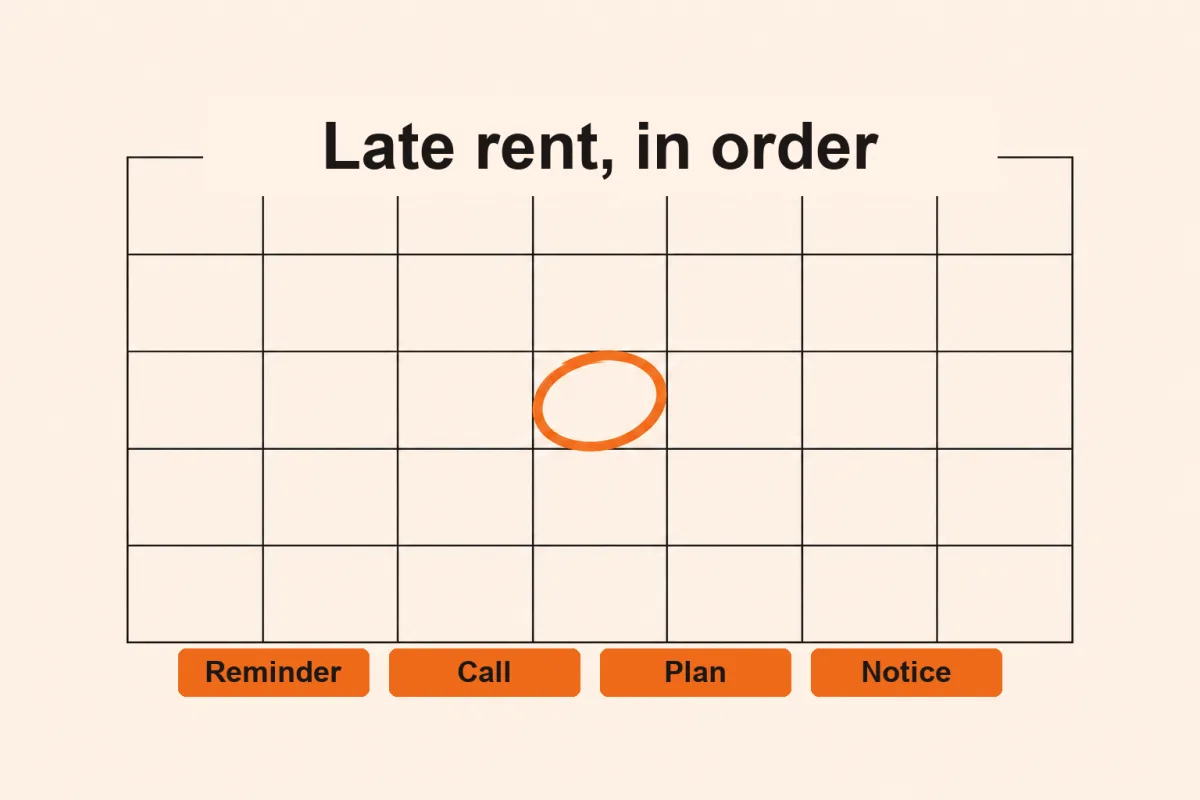
Late rent, in order
The days between stages come from your lease, your policy and local law, not from this guide.
Treat the timing as yours to set and the legal parts as counsel's to confirm. Everything below assumes you will write down your own days.
Stage 1: before the due date
Some companies send a reminder a few days before rent is due and some do not. If you do, keep it short, with the amount, the due date and how to pay. A reminder is a service, not a warning. It should read that way.
Whatever you decide, decide it once and apply it to every resident. A reminder sent to some and not others is hard to explain later.
The best late rent work happens before anything is late. Make paying easy: a clear due date in the lease, a payment link that works on a phone, and autopay offered to every resident at move-in. Each of these removes a reason for a payment to slip. When residents ask about changing their due date to match when they are paid, check whether your lease and software allow it. A resident who pays reliably on the fifth is a better account than one who pays late on the first every month.
Stage 2: the day after
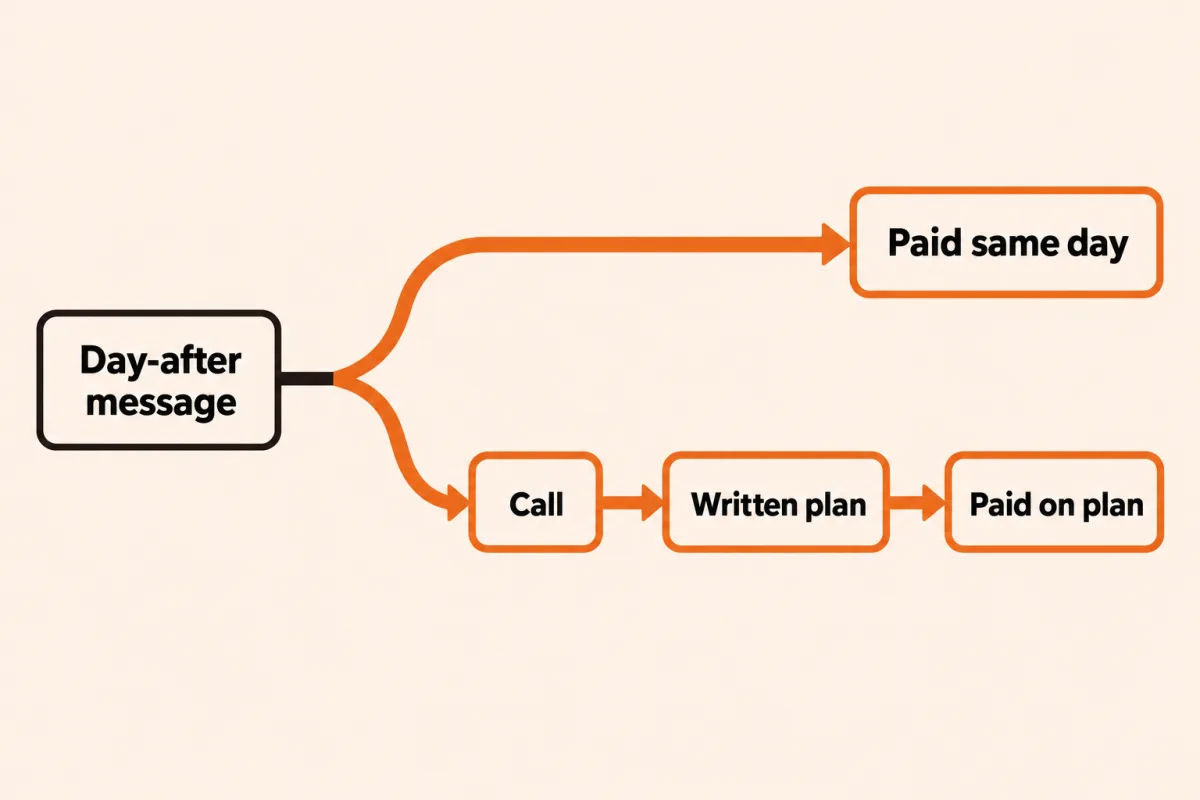
The first late message should assume a mistake. Most late payments are timing, a bank delay or a forgotten autopay. The message states the amount, the date it was due and the quickest way to pay, and nothing else.
Hi [resident name], we have not received [month] rent of [amount] that was due on [date]. If you have already paid, thank you, and please reply with the date and method so we can check. If not, you can pay here: [payment link or instructions]. If something has come up, let us know and we will talk about it.
The wording options for each stage are in late rent reminder templates. Use them as written and swap in your details.
Stage 3: the follow-up
If the first message gets no reply and no payment, the next contact should be a call, followed by a short written note of what was said. A call finds out what is actually going on. The note makes it real.
Write down: the date and time of the call, who spoke, what the resident said, and what they promised. If they promised a date, put the date in a message back to them. "As we discussed, you plan to pay by [date]" is a friendly sentence and a useful record.
Late fees
A late fee is a term of the lease and is limited in many places by state or local law. Two points are safe whatever your state:
- Charge only the fee the lease says, on the date the lease says.
- Apply it the same way to every resident in the same position.
Whether a fee is allowed, when it can start and how large it can be varies by state and by lease. Check yours with your own counsel. When a resident disputes one, the late fee dispute letter covers what to say and what to check first.
Stage 4: a payment plan, or a formal notice
This is the fork. If the resident has a real reason and a believable plan, a written payment plan can recover the money faster than a notice would, and it keeps the resident. If there is no contact, no plan, or a plan that has already failed, the lease and local law set out the formal route.
When a plan makes sense
A plan works when it is written down, has dates and amounts, says what happens if a payment is missed, and is signed by both sides. A verbal plan is a wish. The payment plan agreement template has the wording. Have counsel confirm that a plan does not conflict with any notice already served.
When a notice is next
A formal late rent notice is a legal document. Its name, its required wording, how it is delivered and how long the resident has to respond are all set by state and local law and by your lease. Do not copy a notice from another state, and do not let an AI tool write the legal wording. Use the form your counsel has approved, fill in the facts yourself, and deliver it exactly as required.
This is a working template, not legal advice. Notice names, notice periods, fee limits and required wording depend on your lease and on state and local law. Check yours with your own counsel before using it.
Stage 5: escalation
At some point the matter leaves your desk. That point comes from your lease, local law and your management agreement, and sometimes from the owner. Decide ahead of time who makes the call and who is told. At minimum, the owner should hear about it from you before the statement shows it. The owner update email templates include a version for a delinquent account.
Escalation is easier to handle well when it is planned in advance. Write down three things for each owner: the point at which an account goes to counsel, who decides that, and who tells the resident. Some management agreements already say this; many leave it vague. If yours is vague, agree it with the owner now, while nothing is at stake, rather than in the middle of a dispute. Keep the file ready, too. When counsel asks for the ledger, the lease, every message and every call note, you should be able to send it the same day.
A walkthrough: two late accounts, two paths
Say two residents in the same building miss the same month. The sequence is identical for both. What changes is what each one tells you.
The first resident gets the day-after message and replies within the hour. Their bank changed the account number on their autopay and the payment bounced. They pay that afternoon through the link. The property manager notes the reply and the payment in the file, applies the late fee only if the lease and the company policy say it applies in this situation, and moves on. The whole thing takes a few minutes, and the resident remembers that the message was polite.
The second resident does not reply. Two days later the property manager calls. The resident says they lost hours at work and can pay half now and the rest in three weeks. The manager listens, asks what has changed, and writes down the dates and amounts the resident offers. They do not agree to anything on the call. Instead they check the company policy on payment plans and what the owner has approved for situations like this.
The owner has agreed to short plans when a resident has a good payment history. This resident does. The manager drafts a written plan from the template with the two dates and amounts, what happens if a payment is missed, and space for both signatures. The resident signs. The first payment arrives on time. The second is a day late, and the manager sends the same polite day-after message, which brings it in.
If the second payment had not come, the plan already said what would happen next, and the formal route would have started with counsel's form. Nobody would have had to invent a next step under pressure. That is what the sequence is for.
What to record at every stage
| Record | Why it matters |
|---|---|
| Date and channel of every message | Shows the same treatment for every account |
| Who spoke and what was said on calls | Turns a phone call into a record |
| Any promise of payment, with date and amount | Lets you check the promise was kept |
| Fees charged, with the lease clause | Answers a dispute in one line |
| Notices served, date and method of delivery | The part most likely to be challenged |
| Owner updates sent | Proves the owner was told |
Put these in the resident's file, not in someone's inbox. When a colleague takes over an account, the file should tell them where it stands.
How to talk to the resident
Most late rent conversations go better when they start with a question, not a demand. "What happened?" gets you more than "When will you pay?" It also tells you whether you are dealing with a timing issue, a short-term problem or something bigger.
A few habits help:
- Say the amount and the date every time. Do not make the resident ask.
- Offer one next step, not three.
- Write down what was agreed and send it back within the day.
- Keep the tone the same in the third message as in the first. Pressure goes in the facts, not the adjectives.
Some conversations will be hard. A resident may be angry, embarrassed or dealing with something serious, such as a job loss, an illness or a family emergency. You do not need to solve their situation, and you should not promise what the owner has not approved. What you can do is stay calm, keep to the facts, and give them a clear next step and a date. If they mention a crisis, it is reasonable to tell them about local rental assistance programs if your company keeps a list. Residents who feel heard are far more likely to stay in contact, and an account where the resident keeps talking to you is much easier to resolve than one where they stop answering.
Match the channel to the stage. A text or email is fine for the first reminder. A call is better once you need to understand what is happening. Anything that sets a date, an amount or a consequence belongs in writing, even if it was agreed by phone.
Fair housing law applies to how you treat late payers, too. A sequence applied the same way to everyone is also the best protection. Have counsel review it.
Where AI helps, and where it stops
Late rent follow-up is repetitive, which is where AI helps most. It can sort a delinquency report by stage, draft the next message from your template, and flag accounts where a promised payment did not arrive. It should not decide whether to charge a fee, choose a notice, or send anything to a resident.
Put your sequence, your templates and your delinquency report in a ChatGPT or Claude Project, then send:
Using only the attached delinquency report and the sequence in this Project, sort every account with a balance into: needs first reminder, needs a call, promised payment not received, needs a payment plan offer, and needs review by a manager. For each account, give the resident, the unit, the balance, the due date and the last contact date from the report. Then draft the next message for each account in the first two groups from our templates. Do not draft any legal notice. Do not add a fee or a number that is not in the report. If a date or balance is missing, say so instead of guessing.Read every draft, and check the balances against the ledger before anything goes out. The model drafts. A person sends. The legal steps stay with your counsel's forms.
Do not paste anything into a tool your company policy does not allow. If you have no policy yet, the one-page AI policy is a place to start.
After the account is current
Late rent work does not end when the balance hits zero. Close the account in the file with the date it was paid, the total, and any fee charged or waived and why. If a fee was waived, record who approved it, so the next waiver request can be judged against the same standard.
Then look at the pattern. A resident who is late once in two years needs nothing more. A resident who is a few days late every month may need a different due date, autopay, or a direct conversation about what is going on. Spotting the pattern early is far cheaper than repeating the full sequence every month.
Look at your own process, too. If many residents are late in the same month, check whether something on your side caused it: a payment portal outage, a confusing change in how rent is paid, or reminders that did not send. Late rent is sometimes a systems problem dressed up as a resident problem, and fixing the system is the most efficient collection work you can do.
Finally, keep the templates current. If residents keep asking the same question in reply to the day-after message, add the answer to the message. Every question a template answers in advance is a call your team does not have to take.
Keeping the owner informed
Owners hate surprises on the statement more than they hate late rent. A resident a week behind is ordinary. A resident a week behind that the owner discovers on their own is a call to your office and a question about what else they have not been told.
Tell the owner early and briefly: which unit, how much, how late, what you have done and what happens next. If a payment plan is on the table, give the owner the facts they need to decide, such as the resident's payment history and how long they have lived there, and get their decision in writing. If an account is heading toward a formal notice, the owner should hear it from you before the notice is served, because some owners will want to be involved in that decision.
The same discipline helps when the money comes in. A short "paid in full, closed" message ends the matter and shows the owner that the sequence works. For the wording, the owner update email templates have a late rent version, and if late rent leaves an owner account short, see what to do about a negative owner balance.
A weekly rhythm
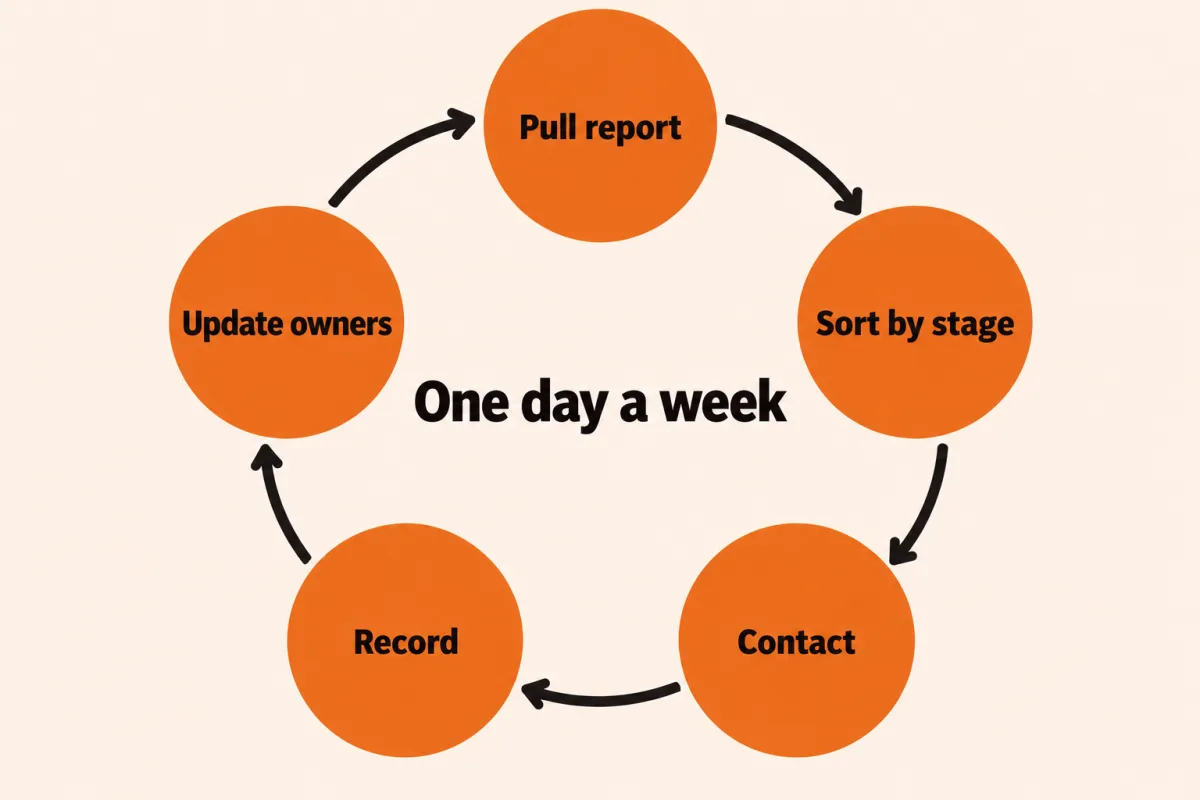
Pick one day for late rent. On that day, pull the delinquency report, sort accounts by stage, work through the list, and record each step. A fixed day stops late rent from taking over the other four. It also makes handoffs easy, since anyone on the team knows when to look.
On the same day, update the owners who need to hear. Short and early beats long and late.
How to adapt it
Small portfolios. With a handful of doors, late rent is usually one or two accounts a month, and the risk is inconsistency rather than volume. The written sequence matters just as much, because the manager is more likely to know the resident personally and bend the rules for one and not another. Write the days down and stick to them.
Large multifamily portfolios. Here the challenge is volume. The weekly rhythm becomes the core of the job, and the delinquency report is the work list. Split accounts by stage and give each stage an owner on the team, so nobody is chasing the same resident twice and nobody is missed.
Single-family homes with individual owners. Owners vary much more in what they will accept. Some want a notice on the first allowed day; others would rather offer a plan. Record each owner's preference in their file so the sequence follows it automatically, and confirm anything unusual in writing.
Your software. AppFolio, Buildium, DoorLoop and Rent Manager can all produce a delinquency report and send bulk reminders. Use them for the routine first messages. Keep calls, plans and notices as individual decisions made by a person, recorded in the resident file.
Common mistakes
- Different treatment for different residents. It is the fastest way to turn a late payment into a dispute.
- Fees without the lease clause. If you cannot point to the line, do not charge it.
- A payment plan that is only spoken. Write it, date it and have both sides sign.
- A notice copied from another state. Use your counsel's form.
- No owner update. The owner learns about it from the statement and calls you.
- Notes in a personal inbox. Put every contact in the file.
Before you send anything on a late account
- The balance matches the ledger, including what has been paid.
- You know which stage this account is in, and the last contact is on file.
- Any fee is in the lease, with the clause noted.
- Any notice is on your counsel's form, with the facts filled in by a person.
- The owner has been told, or will be this week.
Questions
What is the first step when rent is late?
A short, friendly message the day after the due date that states the amount, the due date and how to pay. Most late payments are timing, not trouble.
Can I charge a late fee?
Only if the lease allows it and local law permits it. Fee rules vary by state, so check yours with your own counsel before charging one.
When should I offer a payment plan?
When the resident has a believable reason and a plan with dates and amounts. Put it in writing, have both sides sign, and check it against any notice already served.
Can AI handle late rent follow-up?
It can sort a delinquency report and draft the next message from your templates. A person checks each draft, and legal notices stay on your counsel forms.